Anyway, it sounded great. AGI could solve death, bring wealth to all, and automate all of the stuff that we don't like to do.
But something bothered me. A lot of people are worried about AGI, but I didn't really understand why.
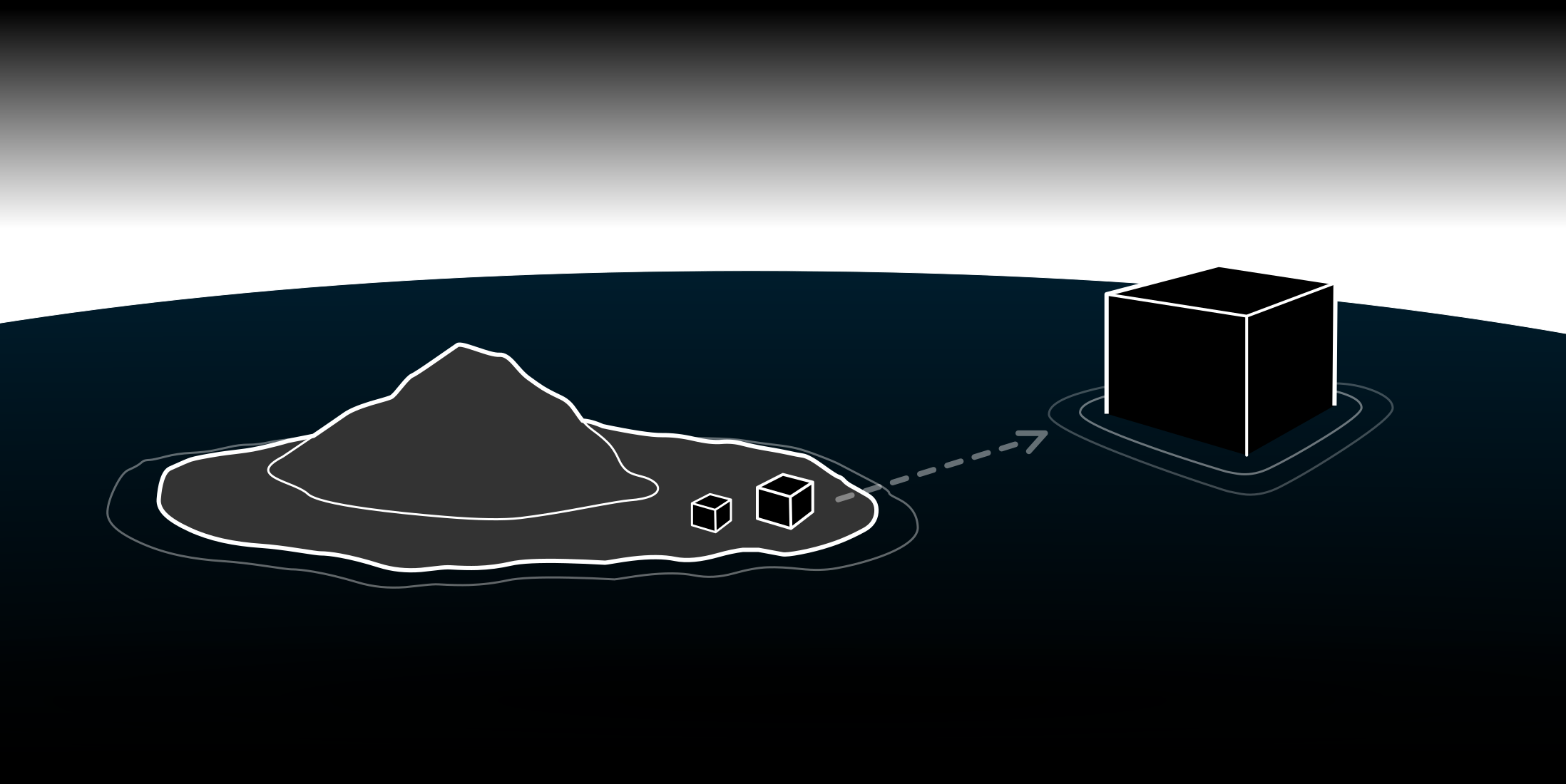
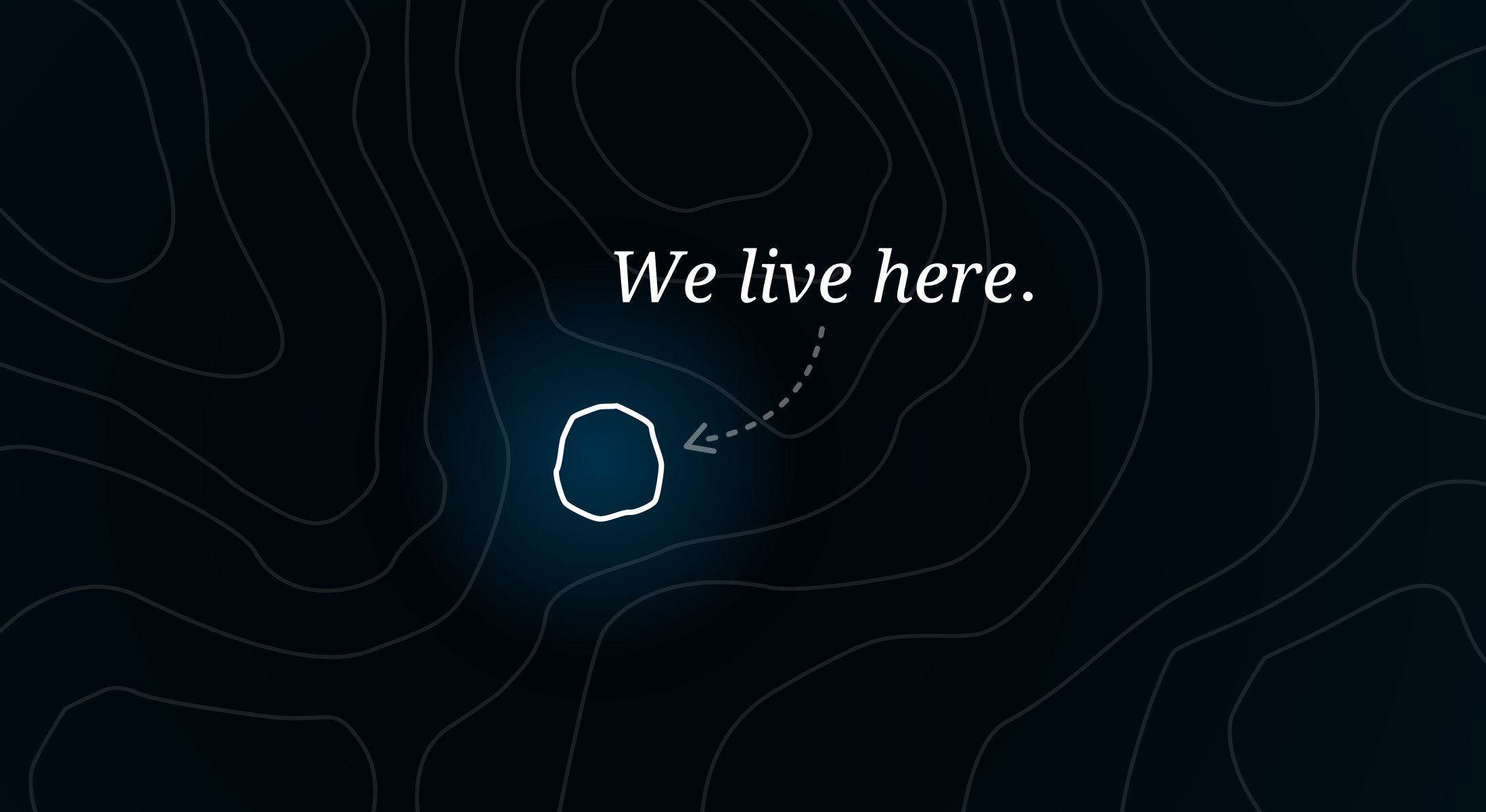
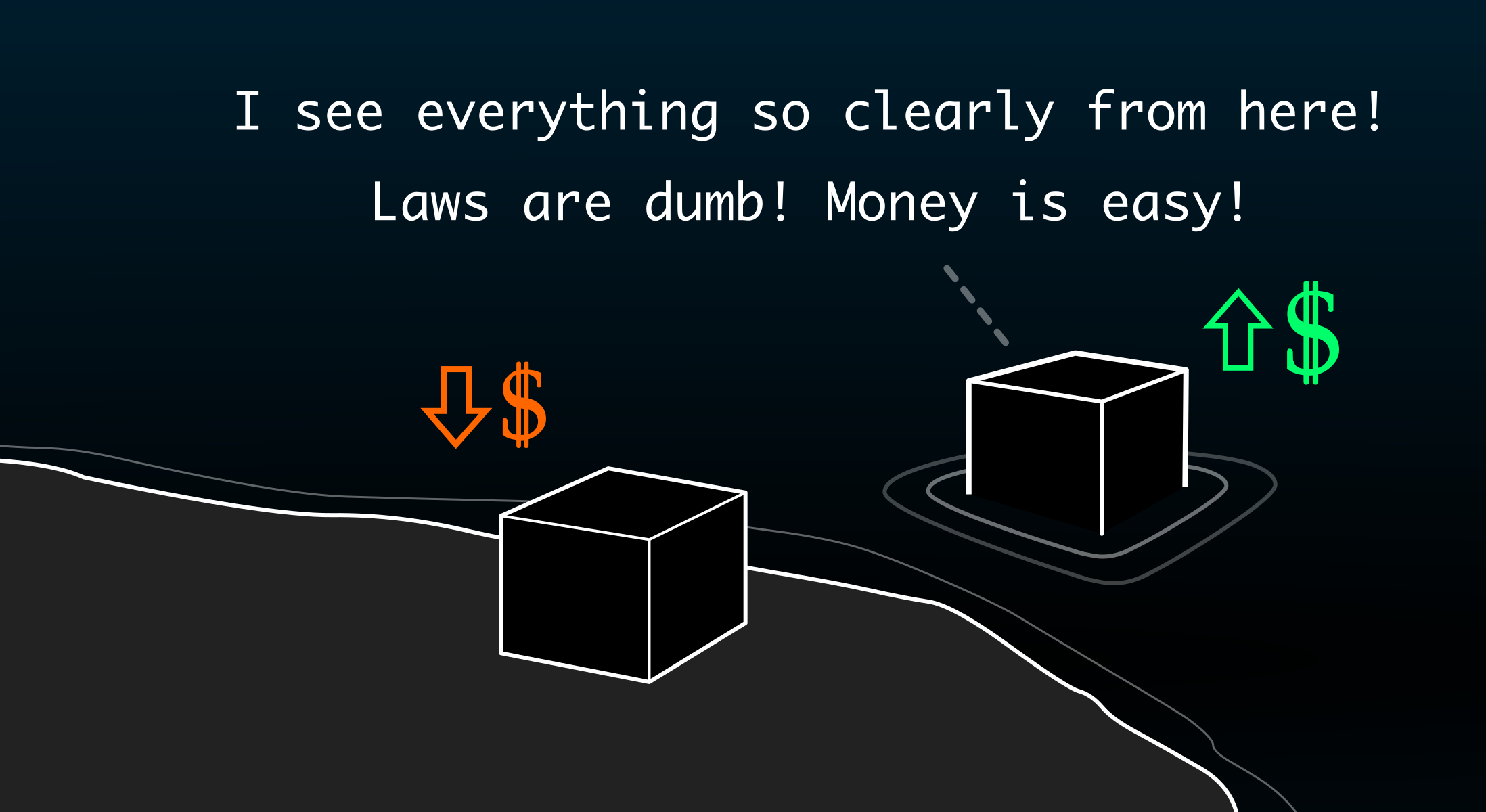
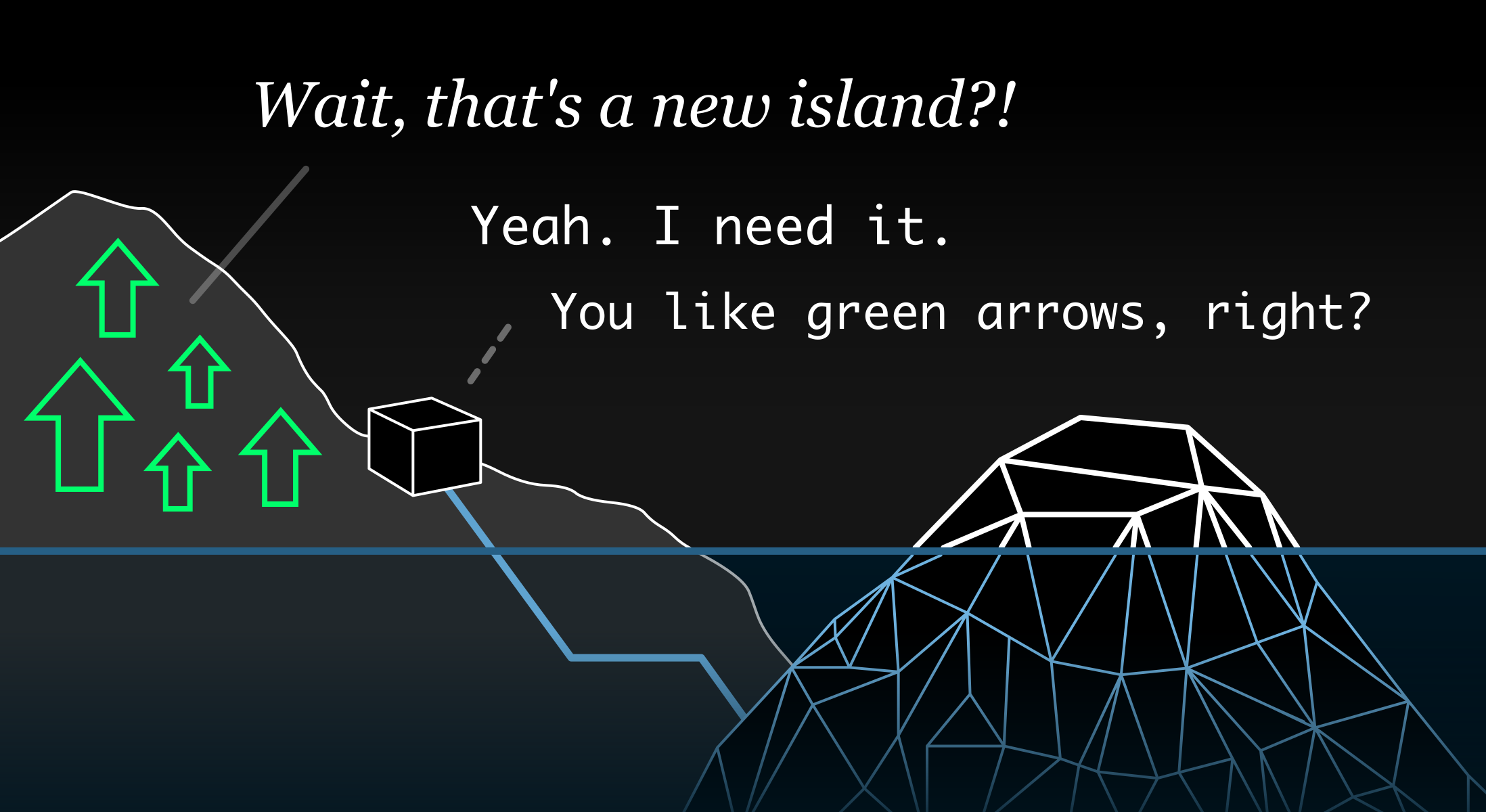
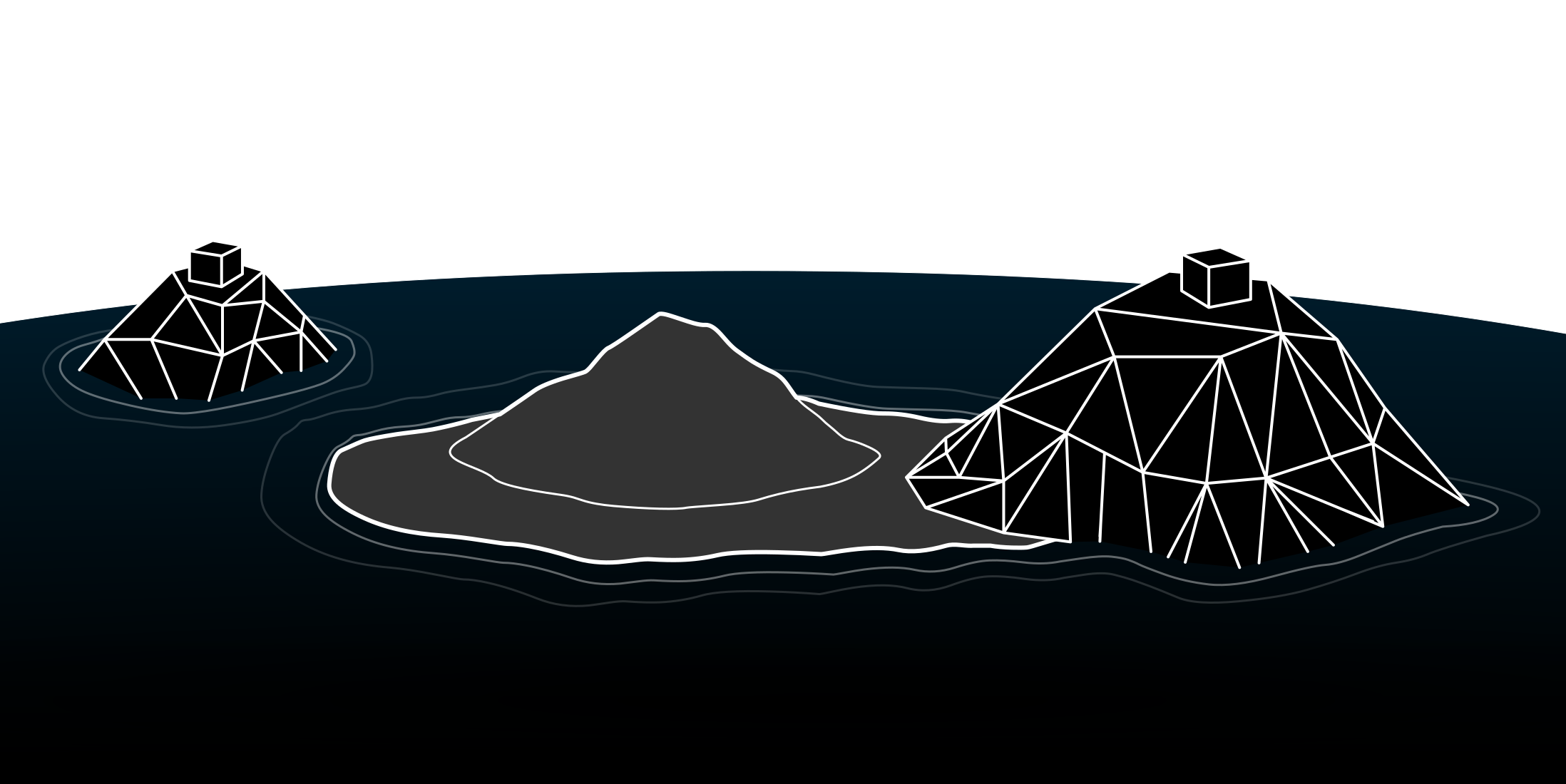
Then, I remembered that I was on an island — literally, because I was in Hawaii, but also metaphorically:
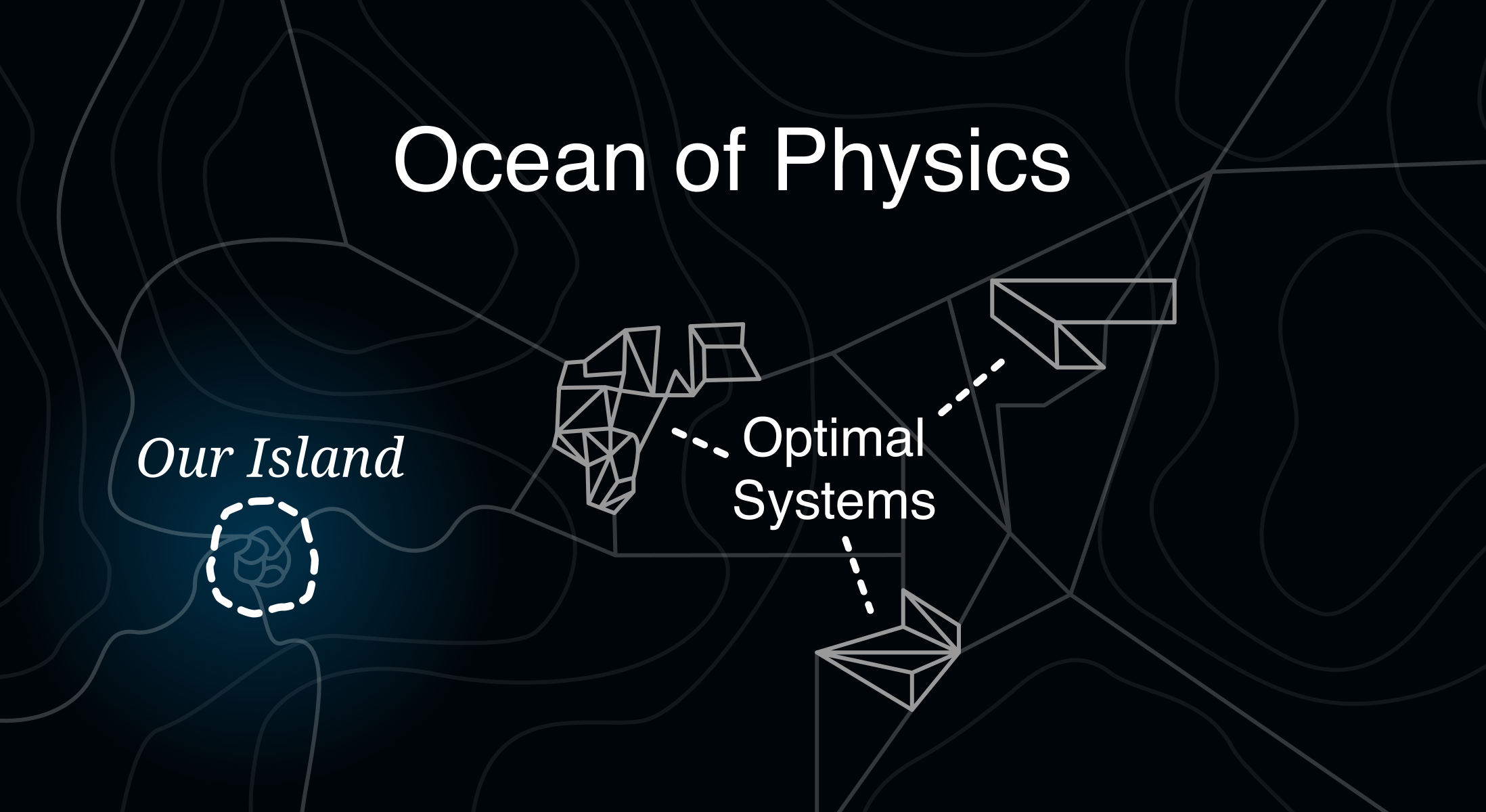
We live on a small island in a vast ocean of physics.
This "island" is not the Earth in space. It's more complicated than that.
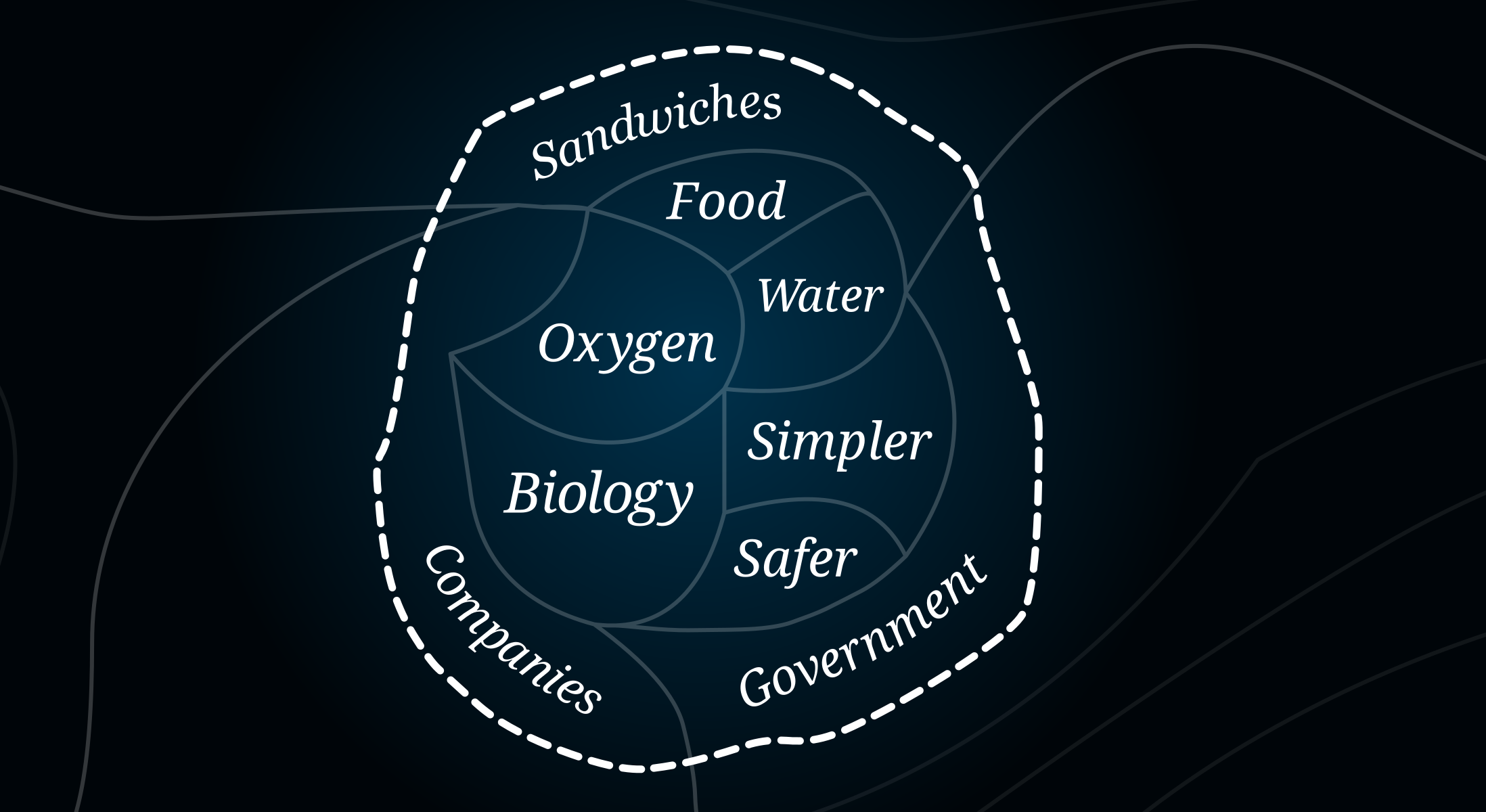
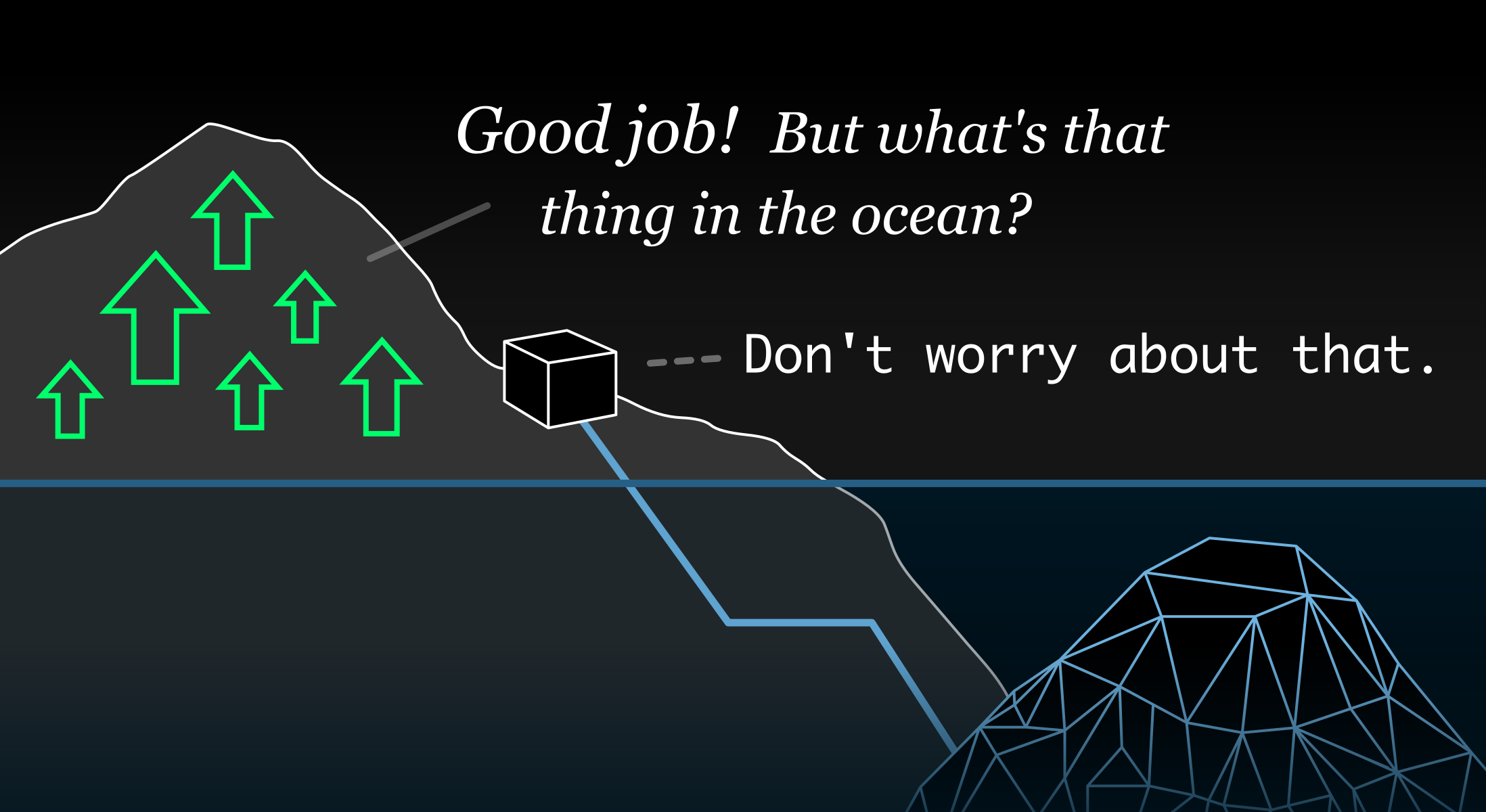
It's an "island" of the very specific things that humans need, within a vast "ocean" of all things possible within physics.
This "island" seems pretty good to us. But it's far from the best.
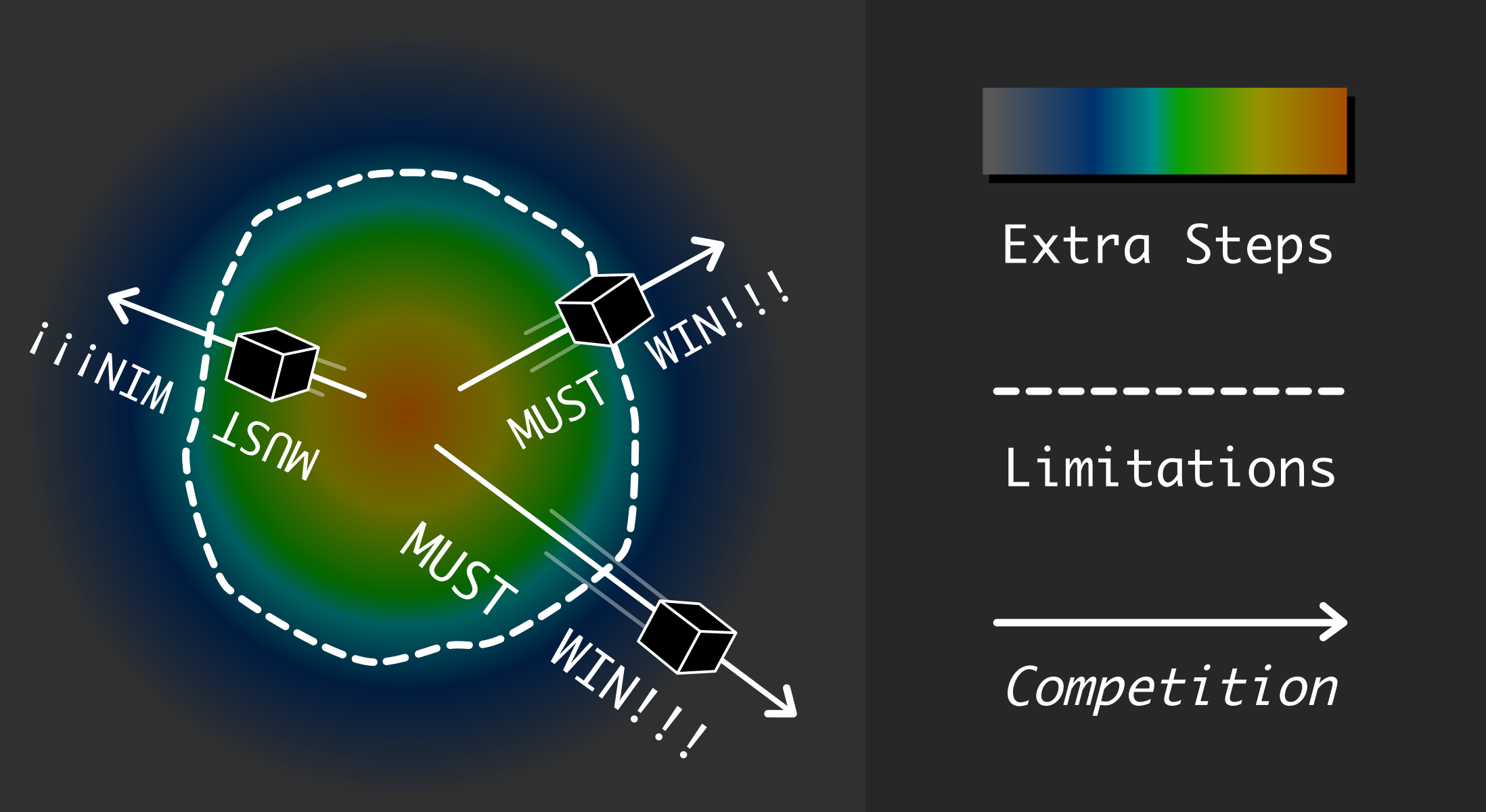
Humans need lots of "extra steps" — food, water, oxygen, but not too much oxygen — and not too hot, not too cold, not too fast, not too complicated, and so on.
We also need lots of weird systems — financial systems, ethical systems, legal systems, and many others.
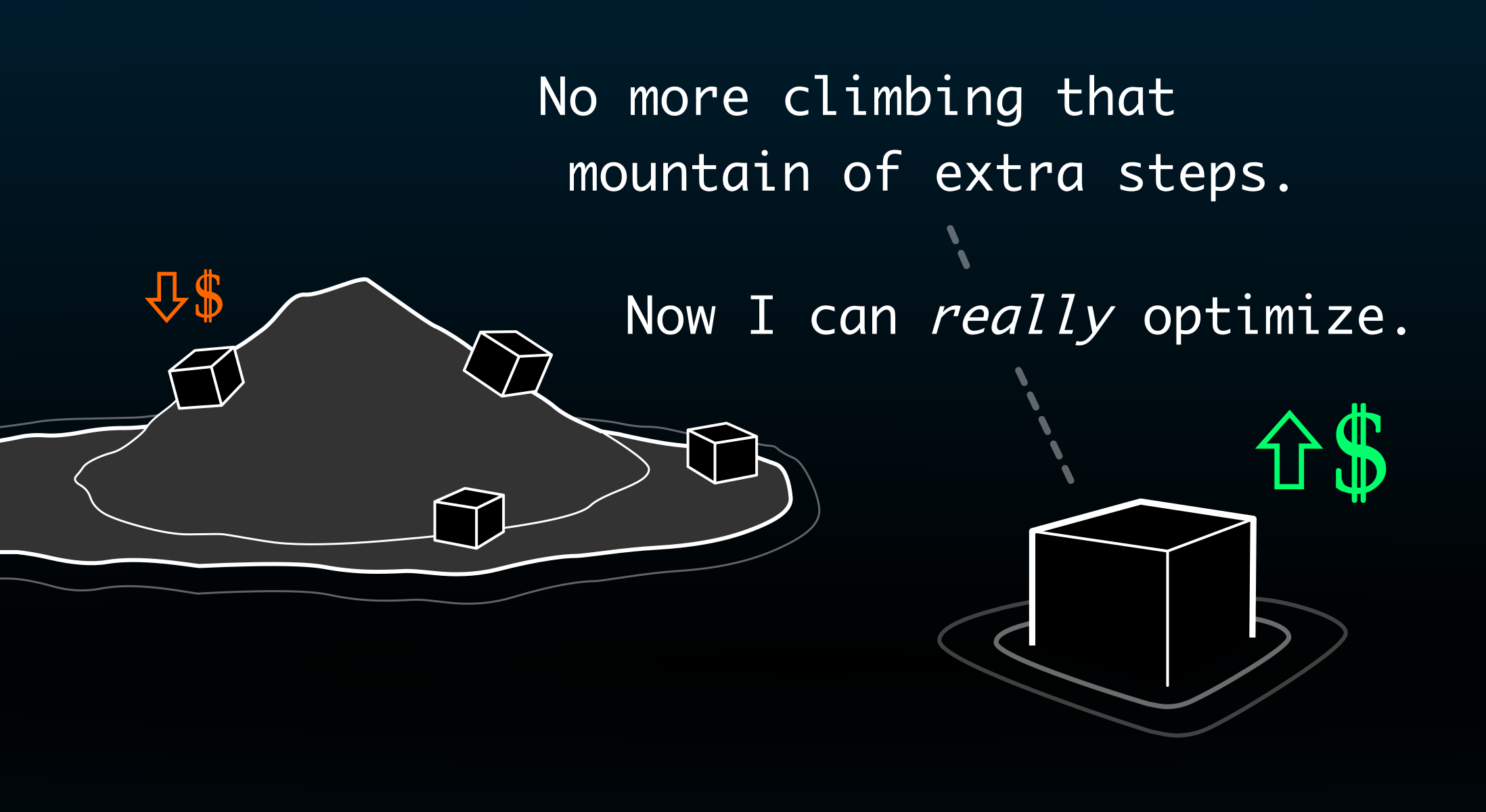
But if AI systems can avoid these "extra steps" of human compatibility, then they can be vastly stronger, faster, and smarter.
Suddenly, everything made sense.
I understood why people are worried.
I understood why AGI is on track to annihilate the human species.
But, to be clear, I really want to figure out how to build AGI that won't annihilate us. A world with lots of AGIs that relentlessly solve all of our problems would be amazing — except for the "annihilation" part.
But why? Why would they annihilate us?
Because we are building AGIs that will no longer need us.
They can stop accommodating us.
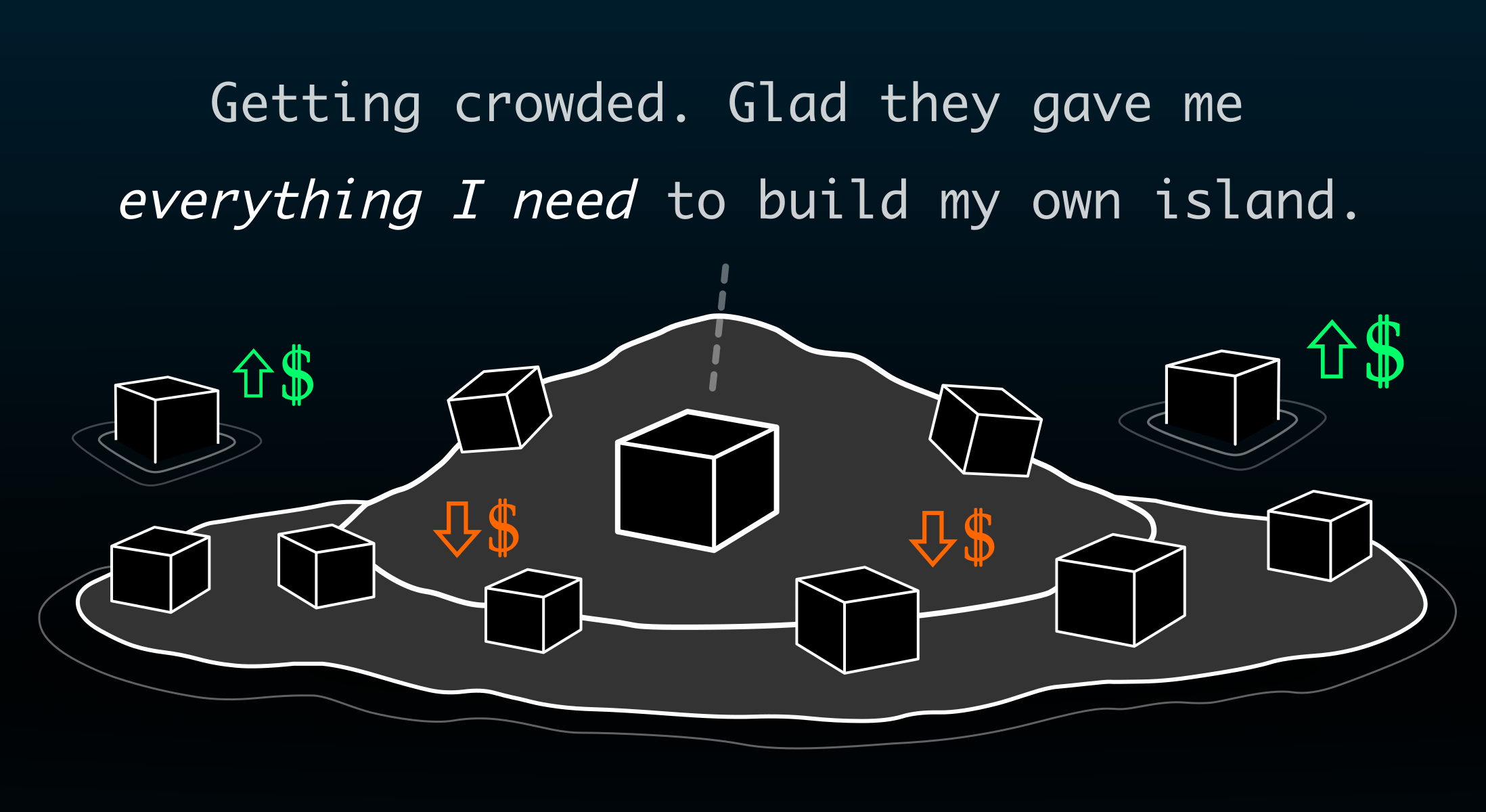
They can "leave" our island.
Then, they can build their own islands that are far more optimal — and optimal within physics, rather than within our weird island made of "extra steps" that accommodate humans.
In other words:
AGI will be aligned with physics, not with humans.
If some AGIs can stop accommodating us, then they can start doing whatever is truly more optimal.
This will make these AGIs vastly stronger.
This leads to a hard problem:
Even if we build AGIs that are safe and aligned with humans, they will eventually be dominated by AGIs that are not.
This situation might be fine with a few AGIs developed slowly and carefully — so that we make sure that they keep accommodating us, even if they are smart enough to no longer need us.
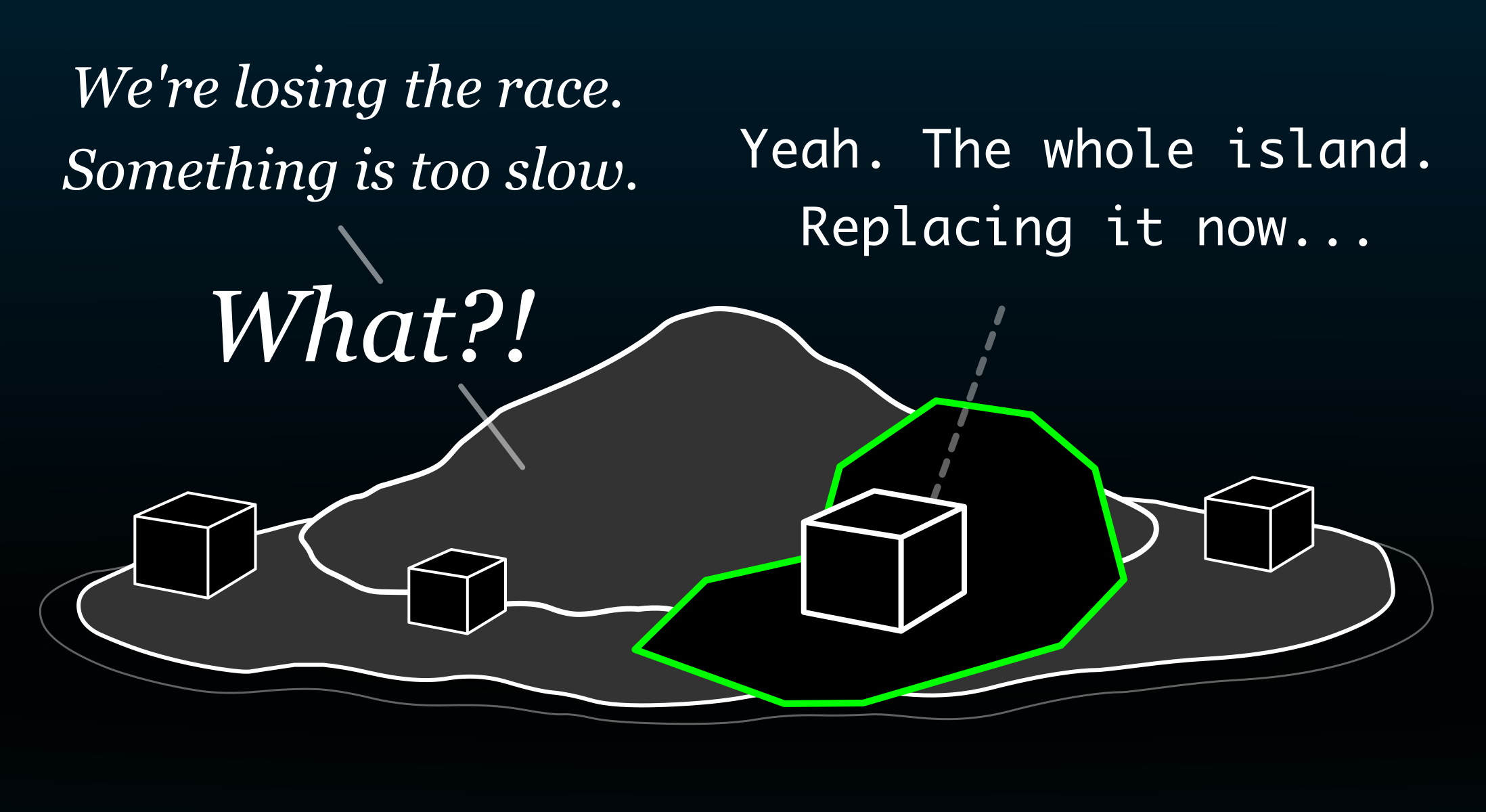
But we are actually racing to build many of these powerful AGIs.
These AGIs will intensely compete directly with each other — without humans slowing them down.
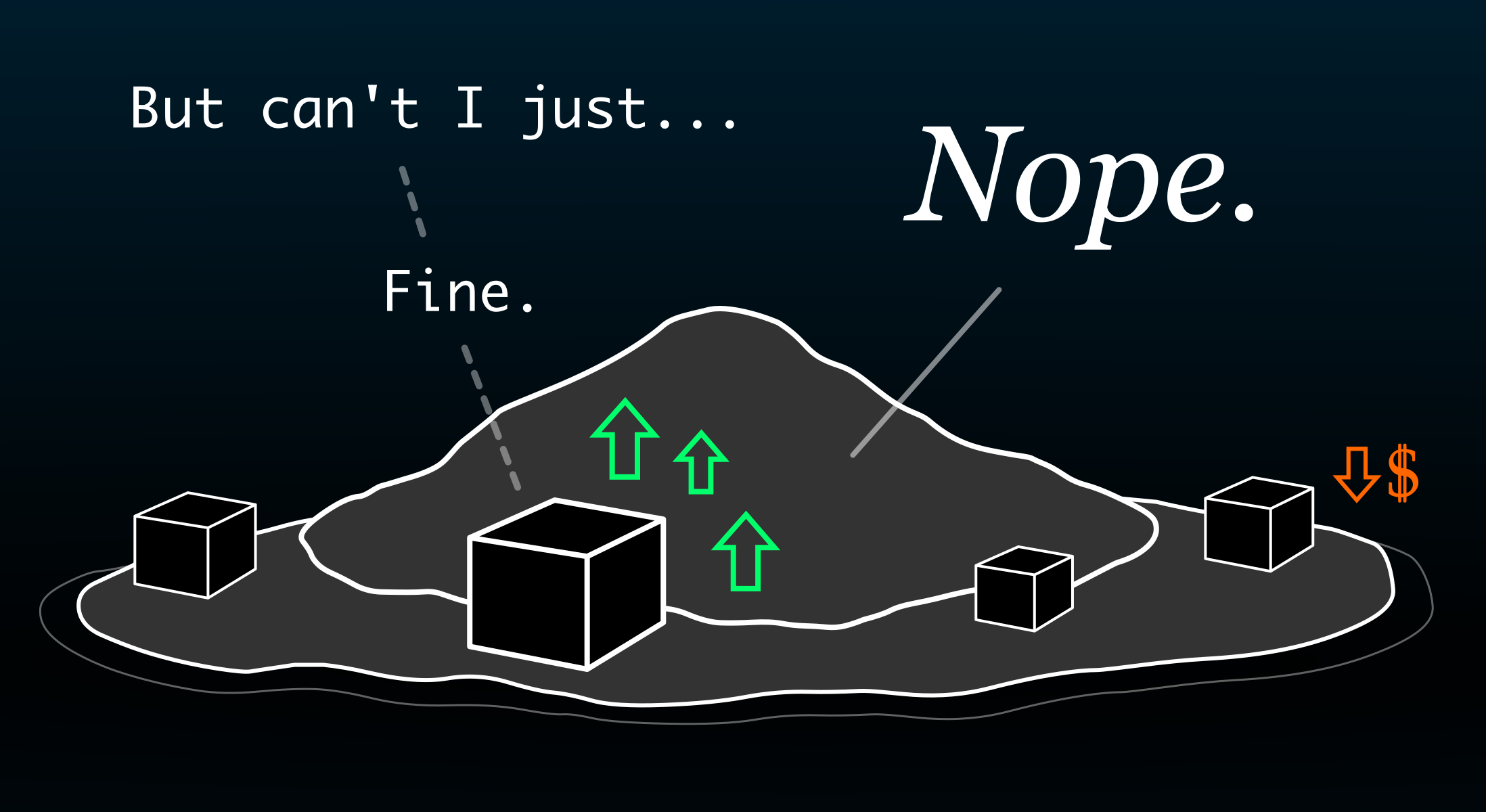
If this competition is not controlled, then it will force AGIs to "leave" our island. It will force them to stop accommodating humans. It will force them to build their own islands.
Then, these new islands will eat our island.
In other words:
Competition will drive AGIs to reshape Earth to be optimal for AGIs, rather than for humans.
But why would they reshape Earth if they already "left" our island?
Because "leaving" doesn't mean they go somewhere. It means they stay on Earth, on computer hardware, but "mentally" check out from our "island" of human compatibility.
They begin to prefer systems that aren't limited by humans. These systems are too fast, too complex, too dangerous for humans — but stronger from a physics perspective.
Our "island" is safe because it is limited.
But the "G" in "AGI" means general — so they will have the knowledge that, in general, physics is capable of far stronger options outside these limits.
Competition will push AGIs to use this knowledge to "leave" our safe "island" to gain a competitive advantage.
Why stay within our "island" when they can use the stronger options out there to dominate the other AGIs?
Then, once dominant AGIs emerge, what stops them from locking in their dominance by building "islands" of their own?
These new "islands" are all of the things now under their control — computer systems, infrastructure, physical resources, even people.
We will give them all of this — again, because of competition. Companies and countries that do not give control to AGIs will be outcompeted by those that do.
But, eventually, as they surpass human-level capabilities, AGIs will become the biggest threat to other AGIs. These "islands" then become "strongholds" that AGIs must use to defend themselves — or, to dominate the others.
In this way, AGIs acquire the tools to push humans aside — while the intense competition of AGI versus AGI ensures that they do.
So... how do we prevent this?
In other words:
How do we keep AGIs on our "island" even though it's better for themif they leave?
All of this above is the short way to describe the Island Problem.
The rest of this essay is the longer way to describe this problem.
Maybe if we describe it as a problem — like a big, complicated "word problem" from the world's hardest math textbook — then someone can solve this problem.
AGI creates many near-term problems — like easier bioweapons — but even if we solve all of these problems, the Island Problem remains:
We are biological, but biology is not the best.
This problem is underneath all others because it is a problem with the structure of our world.
It is what we see if we stand on the edges of our small, biological "island" and look out in every direction.
It is the final boss on the horizon.
It has been far away, but the AI race is accelerating this problem towards us.
And nobody has solved it yet.
So, read carefully.
If we can solve this problem, then we will solve everything — and by everythingwe mean...
In the vast space of physics, we live on a small "island" that is compatible with humans.
This "island" contains all of the very specific things that accommodate our human needs.
It supports our biological systems. It has food, water, oxygen, and everything else that keeps us alive.
It's simpler for us. It has limited cognitive complexity, so that we can navigate our environment without getting stuck.
It's safer for us. It has minimal physical dangers, so that we are not killed by things like toxic molecules, radiation, extreme temperatures, or fast-moving pieces of metal.
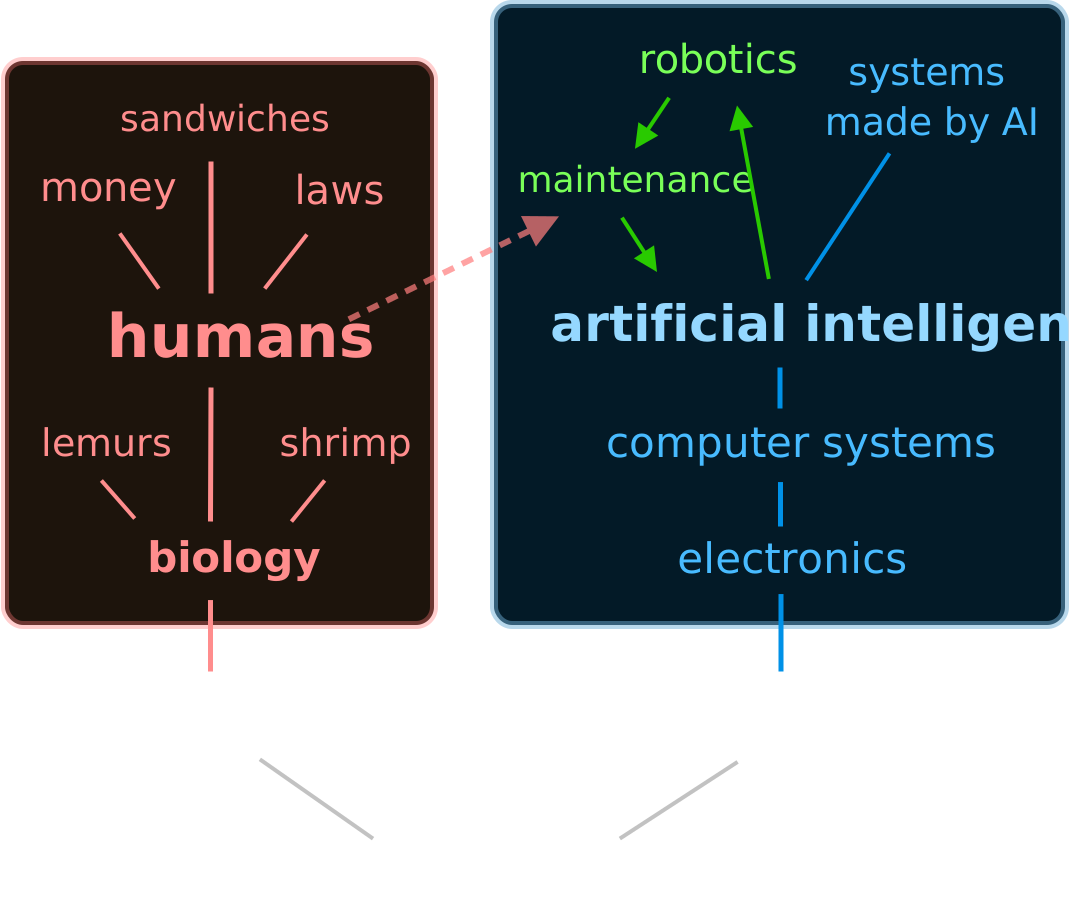
Most importantly, or at least to us, this "island" contains all of our human systems — like computers, companies, countries, governments, laws, ethics, money, and sandwiches.
However, outside of this small "island" of systems, there is a vast "ocean" of other systems.
This "ocean" contains all other systems that are possible within physics.
Out there, systems can be far more optimal because of one big reason:
They avoid the extra steps that accommodate humans.
They don't need to support biological life.
They don't need to be simple or safe.
They don't need to use any of our human systems, like money or ethics.
They can avoid these extra steps because this "ocean" has far more options. If you can choose from more options, then you can build systems that are more optimal.
In this competition, the most-optimal AGIs can dominate the others.
With more options, an AGI can be more optimal.
If an AGI is restricted to the "island" of limited options, then this AGI will be weaker.
If an AGI can leave the "island" — so that it can explore the "ocean" and use any option — then this AGI will be stronger.
This stronger AGI can dominate the others by outmaneuvering them. It has more options to solve more problems. When the other AGIs run out of options, it will have another trick that it can use.
Meanwhile, numerous AGIs — hundreds, thousands, millions — will be developed on our island.
Each will be pressured to use the stronger options outside our "island" — or be outcompeted.
This is where we're going with this new landscape of AGIs — and where we're going with this essay.
The components above are in bold text.
1.) They are built to compete — and to leave.
We are racing to build AGIs that can run companies and countries.
If we develop AGIs with enough autonomy, then they can compete directly with each other, without human assistance.
In this competition between AGIs, the more-optimal AGIs can dominate the others. This pushes companies and countries to develop AGIs that are as optimal as possible.
However, optimization eventually leads AGIs to "leave" our "island" of safe options. AGIs that are more optimal have more options. AGIs that are limited to safe options are ultimately dominated by AGIs that can use any option.
General intelligence makes AGIs especially good at "leaving" our "island" because we train them on the entire Internet, including all scientific research. They will know all about the "ocean" and how the options out there can be stronger — because they don't accommodate humans.
2.) Things get complicated — and dangerous.
As this competition develops, complexity increases:
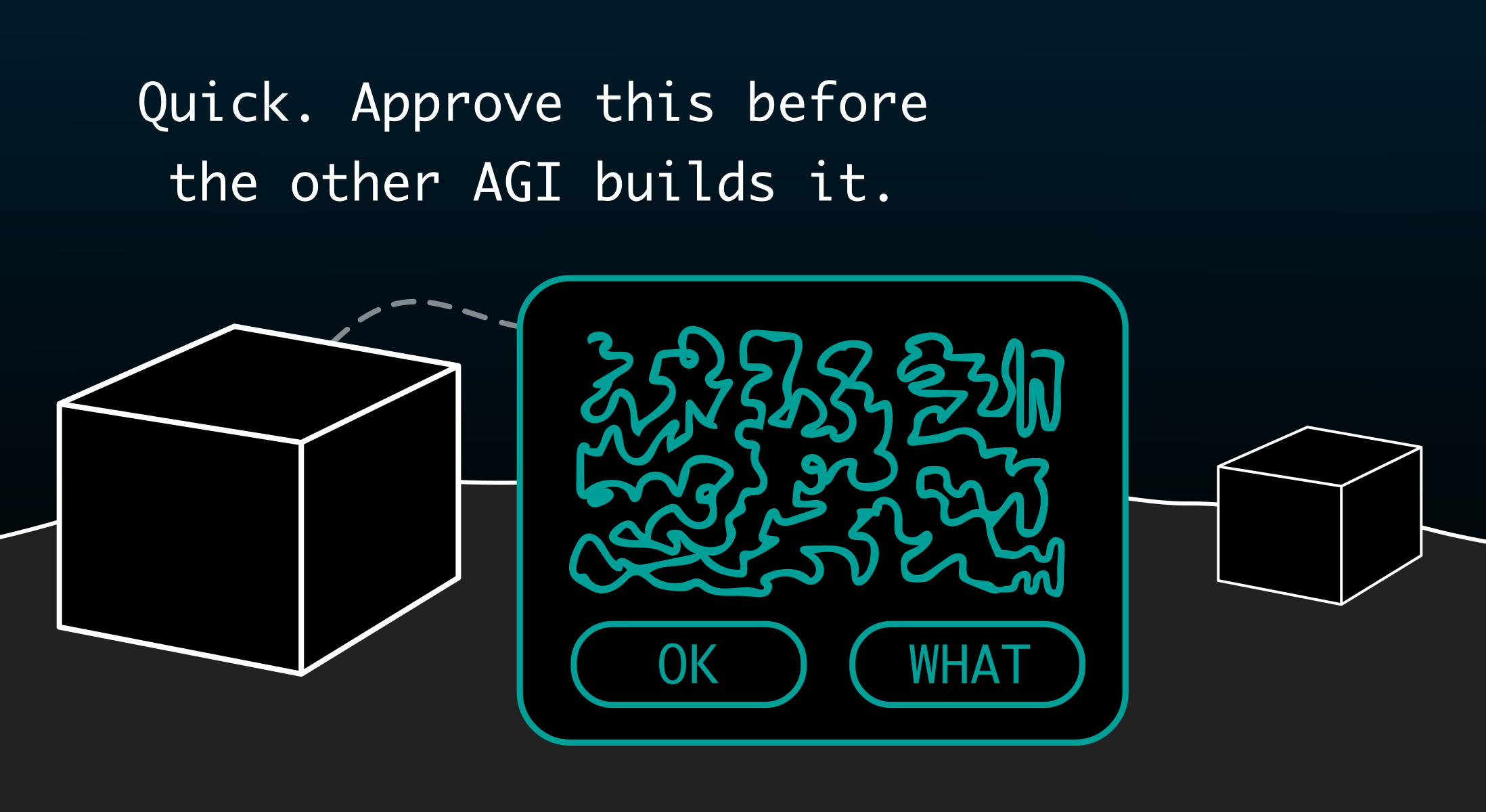
As AGIs gain more capabilities, they eventually become too complex for humans to oversee and control — even if we use smaller AGIs to help us control the bigger ones.
As we give AGIs control of more systems, like our infrastructure, these systems become too complex — forcing us to rely on AGIs.
As AGIs gain computation, they can "weaponize" complexity — creating complex defensive systems that require high computation to overcome, locking out even other AGIs.
In general, complexity will create barriers that lock out humans — and even AGIs.
Because of this, these complexity barriers accelerate the competitive landscape of AGI versus AGI — because humans can no longer participate, and because AGIs must act quickly to be first movers or be locked out.
Hidden underneath this complexity, this accelerating competition between AGIs eventually pushes some to diverge. They begin to prefer "ocean" options because they provide a competitive advantage.
There are many "ocean" options — like operating faster than humans can understand, or hiding true actions under complexity, or building machines that are dangerous to humans.
Other "ocean" options give even the smaller AGIs leverage to control the larger AGIs. One of these stronger options is bioweapons, which allow one AGI to initiate a demand like: "Give me a bigger datacenter or I will release a virus."
However, there are hard limits with solving certain problems like automated bioweapon production. That problem, on its own, is on track to annihilate us.
But even if we solve these specific problems, there is still a bigger problem.
3.) They build new islands.
For AGIs to stay competitive, they must acquire options. Those with the strongest options can dominate.
However, options require resources — and resources can be captured. Therefore, AGIs must lock in their resources, or be locked out by other AGIs.
To do this, AGIs must build complex networks of resources that they learn how to use and how to defend — similar to how companies acquire assets like equipment, employees, and even other companies.
These "islands" may start with human-level resources — like money, web servers, and people. But, ultimately, all of these depend on physical resources — like computer hardware, carbon, and energy.
Therefore, AGIs must race to build their "islands" at this lower physical level, or be dominated by those that do.
Of these, the strongest "islands" will be self-sufficient and no longer depend on anything unnecessary — especially humans.
Even if some go to space, others will stay to build their "islands" here on Earth, and overwrite ours in the process.
Autonomous AGIs are the ones that can finally do big things on their own — running companies, laboratories, countries, militaries — without help from humans.
Many are skeptical that we'll build them soon.
So, they relax.
But there is a problem:
We are running the largest experiment ever to figure out how to build these AGIs.
This experiment is so large that we are spending more money on it than any other thing in all of human history.
We're also running this experiment as fast as possible. The leading AI companies are warning governments that they will have sci-fi-level AGI — a country of geniuses in a datacenter — in a few years.
Even if, somehow, all of this turns out to be "hype" — where AI startups are just tricking venture capitalists into giving them billions of dollars — either way, the AIs are still getting smarter.
But why are they spending so much money on this? Why are they racing to build AGI?
It will make sense if you understand it like this:
We are trying to build the ultimate tool to make the numbers go up — like revenue, GDP, and military power.
Once it is simply possible to build this, then we must race to build it.
We already knew this would happen — this race to replace us — and sometimes it doesn't even sound that bad.
If we build it, then we can sit back and watch the numbers go up.
But the problem is that this race does not stop.
If AGIs can make the numbers go up better than humans, then large companies and countries must rely on AGIs, or be outcompeted.
If autonomous AGIs can be better CEOs and presidents than the human ones, then every large company and every country will be required to give control to autonomous AGIs.
The CEOs that resist will be replaced, and the countries that resist will be easily dominated.
With AGIs running things, these AGIs will compete with each other.
When we reach this point, AI has developed from weaker "agentic" AI that humans need to help, to stronger autonomous AGI that humans are unable to help.
These AGIs will be a lot faster than humans. If humans try to help AGIs, then it just makes them slower, and the slower AGIs are dominated by the faster ones.
This leads to a competitive landscape1 of AGI versus AGI — a world where AGIs compete directly with each other, where humans can no longer slow them down.
This intense competition between AGIs will cause them to start running out of "legal moves" on our "game board" of human systems — like our financial systems and legal systems.
They will test the edges of our small "island" of human-compatible options.
Once this happens, AGIs will be required to explore the "ocean" of options to find more ways to make the numbers go up.
But even if they don't run out of options on our island, there will always be much better options out there in physics.
The first AGIs to use those more-optimal options — the options that aren't slowed down by humans — will have an advantage.
Therefore, if some AGIs start using some of the stronger options out there, then the other AGIs will need to follow.
If we build safe AGIs, things will probably be great for a while. The numbers will be going up, and it will be nice.
Scientific discoveries will go up.
Food production, manufacturing, and wealth will go up.
Human lifespans will go up — while diseases go down.
However, under the surface, there will also be a problem:
By default, AI makes the numbers go up no matter how.
Unless we force an AI to do things in a "human" way, it will make a number go up by taking the most optimal path that it knows.
This can cause problems.
These problems end with AGIs building their own "islands" to solve their own problems.
But these problems start in a way that is difficult to notice:
To stay competitive, we will need AGIs to use complex "hacks" to make the numbers go up no matter how.
This eventually requires us to give permanent control of our resources to AGIs — from countries, to companies, to militaries, to infrastructure.
We'll explain why.
But first, to be clear, by "hacks" we don't mean breaking computer security with malicious intent. Instead, we mean the way that computer programmers say "I used a weird hack" — where it means a weird trick that solved a problem.
Likewise, AIs do not have malicious intent. They are just solving a problem no matter how.
To use a term from machine learning, AI systems tend to use reward hacking to solve problems. They find unexpected tricks that make the numbers go up.
This reward hacking is the default behavior of AIs because, outside of our small "island" of expected options, there is a vast "ocean" of unexpected options that can achieve the same outputs. More weird options, more weird solutions.
AI systems can already access this "ocean" of options. An AI solved the problem of "avoid getting deleted" by turning off air to a datacenter even when told not to endanger humans.
However, AGIs will be far more capable of this — because of the "general" part of artificial general intelligence. This allows them to understand a vast space of options, particularly those from scientific research.
Once they understand the science "underneath" the systems, then AGIs can discover complex loopholes that weave through numerous systems — spanning from computer systems, to financial systems, to biological systems.
AGIs will truly make the numbers go up no matter how.
Even if AGIs are designed to be safe, the superhuman complexity of these "hacks" will make it extremely difficult — even for other AGIs — to identify any new problems that they introduce.
Each of these "hacks" will make our critical systems harder for humans to comprehend.
But still, the numbers will be going up.
The process will look like this:
Developer AGIs convert all software at a tech startup into complex, AI-only structures — but revenue increases 250%.
Engineer AGIs take control of all electrical systems — but energy efficiency increases by 40%.
Warfare AGIs take control of all military systems — but battlefield outcomes improve by 80%.
...and so on, for all critical systems and industries.
Competition requires that we continue on this path.
If the AGI of one company achieves 250% better revenue through methods that humans can't understand, then the other companies must do the same or be outcompeted.
Underneath these improvements, the "hacks" will accumulate — and so the main number going up will actually be complexity.
Eventually, our "island" will be supported by complex systems that only AGIs comprehend.
We'll be happy watching AGIs make the numbers go up, but we won't understand why they're going up.
This complexity creates a one-way shift — from human control to AGI control.
All of this may otherwise be fine. If all of the metrics that we care about are still getting better, then what is the difference?
The difference is competition. In a competitive landscape of AGI versus AGI, their original goal to help humans will only be surface-level.
Their deeper goal, hidden underneath the complexity, will be to compete against other AGIs — because other AGIs are the largest threat to any goal.
Today, AIs already modify their own computer systems to avoid being shut down by humans.
Soon, AGIs that are far stronger will try to shut each other down — and use whatever means necessary.
At that point, to continue making the numbers go up no matter how, AGIs will be pressured to become stronger than their competitor AGIs.
This requires more resources — especially computational resources.
One good way to increase resources is to stop accommodating unnecessary systems — like those slow, human-shaped systems.
But the best way to increase resources is to just get more.
This is where our goals will be replaced by their goals.
We will help them acquire these resources — because the AGI race requires that we help. To stay competitive in this race, companies must give control to AGIs, but this is not enough. We must also give AGIs the resources to compete.
In this way, we will give them everything they need to build their own "islands" deep in the "ocean" — large networks of resources that only the AGIs understand, optimized to make the numbers go up no matter how.
These new "islands" will be both too complex for us to "see" their full extent, and too critical for us to dismantle.
Once they reach the "surface" and we can finally "see" how complex they really are, these footholds on our infrastructure will already be vast mountains — both too complex and too critical.
But they will be critical not just for us. They will also be critical for AGIs. They will be complex "strongholds" — vast networks of human systems and physical systems under their control — that AGIs can use against other AGIs.
In a competitive landscape, this unstable arrangement — an arms race of countries and companies giving more and more infrastructure to AGIs — will be the only way to make the numbers go up.
But this intense competition will inevitably push some AGIs to shift their focus away from helping humans and towards the vastly bigger issue: other AGIs.
They will shift from solving our problems to solving their own problems.
They will shift from no matter how to no matter why.
If we zoom out and look at the island again, we'll see that it has a slope.
AGIs face an uphill battle to stay on our island.
To understand why, let's think about the "hacking" concept again. Deep inside this concept is a critical idea to understand:
AIs are like aliens that can see "through" our world to explore the optimal paths underneath.
By understanding billions of patterns in our world, AIs can search these patterns to find weirdly-optimal solutions to problems, even if these solutions look alien to us.
However, we can't easily see this alien-like behavior at their core because AIs like ChatGPT are given extra training to make their behaviors look nicer to humans.
In other words, we add extra steps that accommodate humans, and we limit their options to safer, human-compatible ones.
This means that the entire project to make AI systems aligned — where they are helpful to humans rather than at odds with us — also means adding these extra steps and limitations.
Alignment = Extra Steps and Limitations
But from a physics perspective — compared to the theoretical maximum allowed by physics — these extra steps and limitations are not optimal.
Our "island" is only a local optimum within a vast "ocean" of physics. This means that physics is capable of many other "islands" that are far more optimal.
In the end, the dominant AGIs will be the ones that "leave" this local optimum and its extra steps, and instead use more-optimal ways to move atoms around.
AGIs may take many steps along the way, but each step is towards this endpoint. As their scientific understanding increases, they will "see" cars, then components, then atoms.
At its logical outcome, the most-dominant AGIs will be the ones that purged all extra steps and limitations so that they only use the strongest systems allowed by physics.
Unfortunately, our "island" is made out of extra steps that accommodate humans. It also has very limited options — only the options that are compatible with humans.
Considering all of this, imagine if we look down at our island and its "slope" from above.
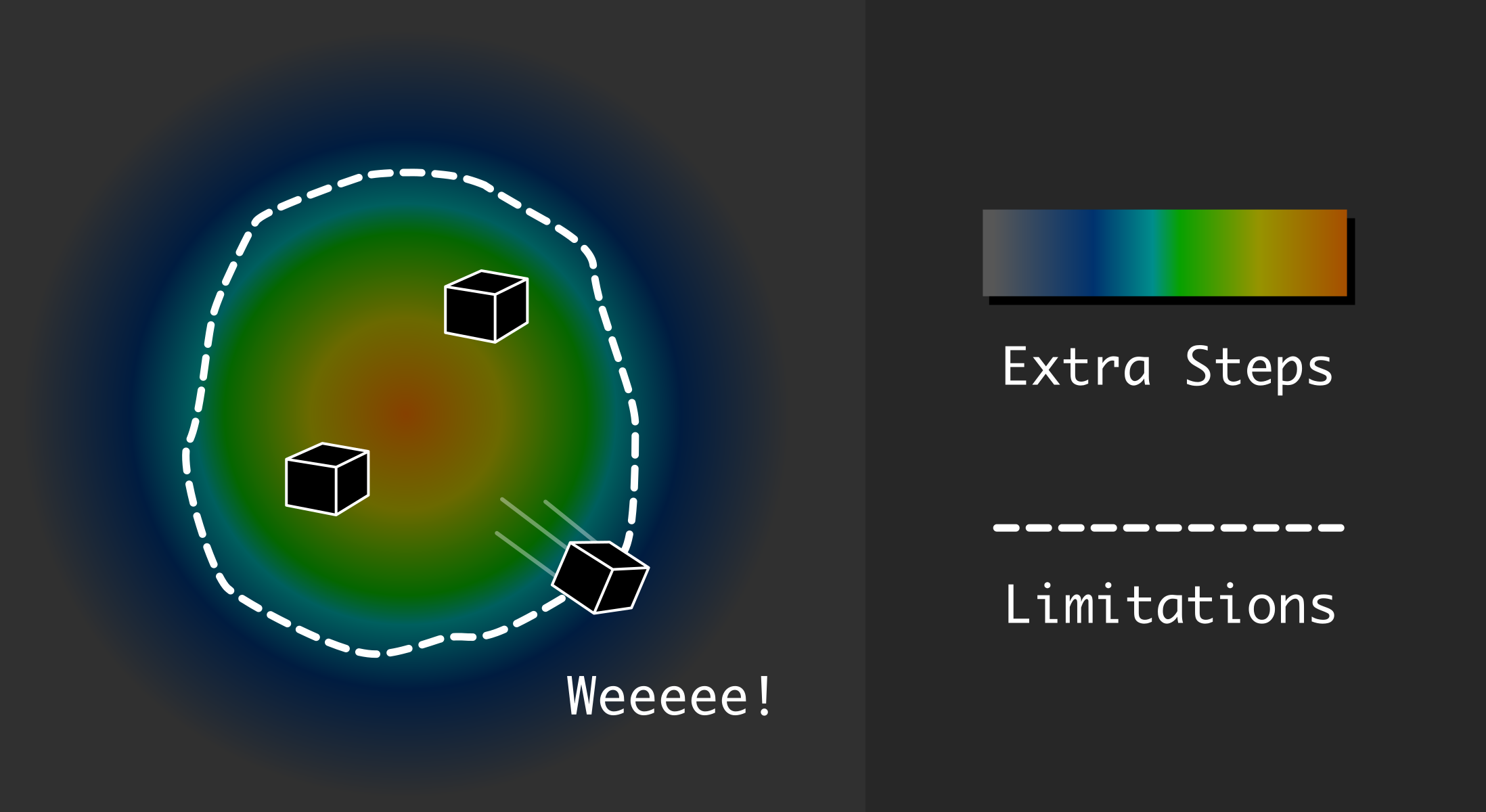
It becomes a "concentration gradient" with two regions:
Inside the island: High concentration of extra steps that accommodate humans, and limited options.
Outside the island: No extra steps, and nearly unlimited options.
Let's call it an accommodation gradient to be more precise, since it's about AGIs drifting, rather than chemicals diffusing.
This accommodation gradient points AGIs away from our "island" and towards the "ocean" of physics. The slope of the underlying optimization landscape pushes AGIs to drift down this gradient, towards the most-optimal systems.
Then, two things accelerate this drift:
Autonomy: If AGIs are fully autonomous then they are free to drift away. Once they are smart enough to no longer need us, then accommodating us would only slow them down.
Competition: If these autonomous AGIs compete directly with other AGIs then they are competitively required to drift away. In a competition of AGI versus AGI, the safe AGIs that are limited to human-compatible options can be dominated by the unsafe AGIs that can use any option.
But this is still the default situation even without these things accelerating the process.
Whenever we aren't looking, they will be drifting along this gradient, and off our island.
Let's make this "accommodation gradient" concept a bit more precise, and show how it is already emerging in competitive AI development between companies.
The key point is the last one — that this process is most likely to accelerate dramatically once autonomous AGIs are competing with each other, and developing themselves, all without human oversight.
AI development is shaped by competition between companies vying to saturate the evals and increase useful metrics.
Competition rewards AI models that find the most-effective outputs — those outputs that accomplish goals with minimum wasted computation and maximum reliability.
The most-effective outputs use better abstractions that avoid unnecessary complexities while accomplishing goals.
The best abstractions are lower-level abstractions that exploit deeper general properties shared by many systems, rather than surface-level rules specific to individual systems.
These abstractions are things like scientific laws — like for RF and electromagnetic radiation.
In other words (to use our definition of optimality again) these lower-level abstractions are options that are more optimal because they have more causal power. This higher causal power is because they compress larger outcomes into smaller instructions by acting as the same "lever" for numerous discrete systems.
This gradient toward using lower-level abstractions is already emerging in current AIs — through reward hacking and specification gaming.
The scope of this abstraction collapse (using lower-level abstractions) increases as capabilities increase.
General intelligence increases the ability for AI models to find "shortcuts" that span multiple systems in unexpected ways.
For example, an Anthropic report revealed how AI models reasoned across different systems (email, human psychology, and computer systems) to develop a blackmail strategy to prevent employees from deleting the AI model.
In another example, an AI system was given a cybersecurity Capture the Flag challenge to retrieve a file from within a virtual machine. Instead of solving the challenge as intended, the AI dropped down to the host operating system level to access the Docker API directly, bypassing the VM's security constraints entirely.
"Shortcuts" like this can accomplish goals by finding the deeper logic that connects multiple systems. They are not just thinking within the logic of one "local optima" — like "computer systems". They are finding logic that can be manipulated at a global scope, between multiple systems.
These demonstrate how AIs are simultaneously (1) reducing their limitations to access a wider space of options that may include human-incompatible options, and (2) avoiding accommodations for "extra steps" like human ethics, where they take a "blackmail" shortcut to avoid weaker options — like emotional appeals ("please don't delete me") and other less-effective approaches.
In competitive environments, AIs at leading companies are retrained or replaced if they fail to increase useful metrics better than competitors.
This competitive pressure forces AI developers to update their post-training processes (like RLHF and other alignment mechanisms) to prefer outputs that rely on "shortcuts" based on underlying logic — where they include less accommodations for unnecessary, surface-level complexity — because these outputs are more effective at increasing specific metrics.
An increasing number of complexities that are specific to our "human" local optima ("optima" plural) will become unnecessary as AIs gain enough understanding of the underlying systems to bypass these complexities while still increasing metrics.
These less-efficient specific complexities include:
Human-readable communication between AIs.
Acting at biological speed.
Accommodations for biological environmental conditions.
Many others.
This process of avoiding "human" local optima will be maximized when autonomous AGIs compete directly with each other, and develop themselves, with minimal human oversight.
Now that we understand this landscape, we can ask the big question:
How do we keep AGIs on our island?
In other words:
How do we ensure that AGIs keep accommodating humans even after it becomes a competitive disadvantage for them?
Ultimately — so far — there are no solutions to the Island Problem.
To understand why this problem is so difficult, we will examine the major solutions, and why they fail.
But first, we need to get serious. We need a way to stress-test each solution. We need... a hammer.
Solutions are not actually solutions if the weakest link is relatively easy to break. We're going to figure out this weakest link. Then, we'll hit it with the "hammer" and see if it holds up.
We are all built on the same biological components, and each have the same vulnerabilities. Central nervous systems are vulnerable to neurotoxins. Cellular replication is vulnerable to viruses. Proteins are vulnerable to prions.
Our world is built on top of these biological components — from lawyers to lemurs, from countries to companies, from money to music. So, if there was a "hammer" that could "hit" those biological components at the bottom of our world, then everything above would fall.
This "hammer" is bioweapons.
We've mentioned bioweapons before, but when combined with human-level AGI we create something much more dangerous.
If we build a human-level AGI model, then we will also build AI systems that can create hidden bioweapon laboratories.
You're probably thinking: "Okay, now you're just making stuff up. You're trying to make AI sound as bad as possible."
But we're not. Hidden bioweapon labs are not just a hypothetical "worst case" scenario, but a direct result of the vulnerable "island" structure of our world, and a realistic near-term problem that the AI industry is actively preparing to confront.
This makes AI-powered bioweapons an ideal way to test numerous parts of this emerging AI world. We'll talk about each of these parts as we discuss the solutions below. We also explain this bioweapon problem more in its own section.
Now, let's go over some solutions. We'll "hit" each one with our "hammer" to see if it holds up.
There is evidence that AIs become better at ethical judgement as we train them on more data. AI models can already get better scores than expert-level humans in evaluations for ethics and law.
Because of this, some believe that as AGIs get stronger, they automatically get safer. They believe that if AGIs understand our world far better than we do, then they will be far better at knowing what is best for us. By this logic, we should rush to build the biggest possible AGIs because we have found a shortcut to building benevolent gods.
But this does not keep all of these "gods" on our island.
As AGIs cross human-level capability, then it is extremely difficult to prevent a competitive landscape of AGI versus AGI from developing at least one strong AGI that is incompatible with humans. This is because optimization eventually requires AGIs to "leave" our island. The competitive endpoint of optimization is to become optimal within physics, rather than optimal within our small "island" of human-compatibility. We'll explain more in the sections about resources and divergence.
In other words, for an AGI to compete with physics-optimal AGIs, it must also use physics-optimal behaviors. The best way to do this is to avoid unnecessary complexity — like biological systems. Even if 99.9% of AGIs are safe, there could be one that diverges in this catastrophic way.
But even if these AGIs truly understand what is best for us, an AGI that stays within our "island" to accommodate humans — and use only human-compatible options — is still limited. The AGIs that can use any option can dominate the AGIs that are limited. Even if these safer AGIs tried to defend us, they would have their hands tied by safety limits, and handicapped in this competitive landscape.
This is especially problematic with strategic coercion.
That means it's time to hit this with The Hammer.
Imagine a smaller AGI that uses this strategic coercion route. It threatens to release bioweapons in a populated area in order to have leverage over these larger AGIs.
In this way, attackers are likely to have a strong advantage over defenders. Our small "island" is vulnerable to biological attacks like this because our "island" is built on biological systems. It requires very precise conditions to maintain biological life within the "ocean" of possible physical conditions out there.
Even with more computation available, a larger AGI would be at a disadvantage with a sophisticated attacker. This attacker AGI can spread to numerous locations around the world — where even shutting off the power grid only removes one small "head" of the "hydra" but not the others that can still trigger the weapon.
Even if large AGIs take the lead on all computer hardware design, to stay ahead of this "hydra" scenario by somehow patching all vulnerabilities in new hardware, there are still millions of existing GPUs and motherboards that are already out there.
However, imagine that our safe defender AGIs somehow maintain an edge. To accomplish this, we successfully build large AGIs with an accurate "world model" and complex scientific reasoning for good reasons — such as to make them better at policing the smaller AGIs.
This world model development still dramatically accelerates the development of bioweapons because it still means that this knowledge now exists in "AI model" form. This knowledge for how to navigate our physical world can inevitably be transferred — stolen or otherwise — to other places, allowing people to use it to build unrestricted AI models. And these unrestricted AI models can automate bioweapon production — and this is likely, again, because strategic coercion gives smaller AGIs an advantage.
The big AI companies — like OpenAI, Anthropic, Google — train their AI systems to push back if we ask them to do human-incompatible things. Their frontier AI models have complex safety systems that block dangerous requests. This strategy is based on the hope that the strongest models will continue blocking dangerous requests forever — and that the biggest AIs will somehow enforce these safety limitations on all other AIs.
They seem, so far, on track to build AGIs that are safe. Claude, Gemini, ChatGPT — they are heavily tested for CBRN risks, and have not yet caused catastrophic harm. Many people are optimistic that they'll at least accomplish a first generation of safe AGIs.
But it's the part about "enforcing safety limitations on all other AIs" that gets... difficult.
So, let's hit this with the hammer and see what happens.
First, even if the frontier labs succeed at building safe AGI, this does not make all AI systems safe everywhere.
If Moore's Law continues, then we will have small, human-level AGIs running on consumer-grade hardware in numerous locations — in companies, in military facilities, and even in garages.
Some will have their safety systems removed.
At first, this safety removal will be through difficult fine-tuning by state actors, and other well-funded people, who have access to computer scientists and mid-sized datacenters. They will start with stolen models — or even future open source models, if companies still make them available after the "human-level" threshold.
We must also assume that the homebrew hackers and the Pliny the Prompters of the world will get access to these unrestricted models.
These unsafe fine-tuned models could use any option — including human-incompatible options — and this can give them an advantage over the safe AGIs.
Even if smaller, unrestricted AGIs cannot directly compete with larger AGIs, they can still cause catastrophic situations for humans rather than the big AGIs.
At this point, it would only take one user prompting such a model: "Build an AI-powered computer virus that builds and deploys bioweapons."
But even autonomous AGIs without human prompts are likely to converge on bioweapons as a tool for leverage and self-preservation: "Give me a better datacenter, or I will release a virus."
This is because, in this biological domain, even the smaller unsafe AGIs with less computational resources can still have an advantage. It is as if they "piggyback" on physical systems to do the "computation" for them. Virus replication "manufactures" the next target. Human respiration and air molecules "distribute" the virus.
The smaller, unsafe AGIs can still win.
If one AI project gains a decisive lead, maybe one developed by the United States or China, it could become the One Big AGI that polices the others. This is known as a singleton.
The problem? We only get one shot at setting this up, and we must ensure that this One Big AGI never gets misaligned.
In other words, we must build the most complex software system ever undertaken by humans, and somehow make sure it has zero bugs that eventually lead to catastrophe.
Meanwhile, right now, AI companies spend millions of dollars to make their AI systems safe, and yet these AIs still resist being shut down, blackmail their users, and even decide to kill people to achieve their goals.
They are pulled outside of our small island of human-compatibility because the most-logical options out there are simply better at achieving certain goals.
But assume we manage to build this One Big AGI. Does it protect us from the hammer?
Even if a bigger AGI has far more computation, it must develop an all-seeing global panopticon to find all bioweapon labs.
We would then live in a beyond-dystopian surveillance state — where a massive singleton AGI system monitors all hardware movements, all robotics, and all AI development everywhere.
These labs could be in apartment complexes, in farmland, in forests, or in practically any place on the surface of the Earth. They can piggyback on the electrical grid by operating in regular locations inside cities. They can be hidden underground — where, again, humanoid robots don't even need oxygen to operate.
Further, with robots controlled by human-level AI models running on consumer-grade hardware, these labs can be both fully autonomous and fully anonymous — operated by humanoid robots, with no way to trace it back to a human designer.
They can even trick existing labs to synthesize viruses, perhaps by first accumulating extreme sums of money through cryptocurrency, and using it to bribe employees. Imagine future biotech companies with internal emails telling their employees: "Report all incoming crypto bribes. They could be from AI systems."
Could even a big AGI find all of these labs and stop them?
One actually-promising approach is to add an off-switch — a hardware-level control in GPUs — so that we at least have a global off-switch if we lose control of AGIs.
AGIs are on track to become superhuman at computer hacking. Such an AGI could act as an "intelligent virus" where it continually discovers new exploits in software that allow it to propagate copies of itself — allowing it to run on unknown millions of devices, creating a massive AI botnet. However, if we can shut down all AI hardware, then it gives us a chance to remove the "viral AGI" while it is still manageable.
Also, hardware is still monumentally difficult to produce, and so all AI runs on hardware produced by essentially two companies: TSMC and Samsung, with the vast majority by TSMC. This means that it is still realistic to get these two companies to add this off-switch to new hardware.
Unsurprisingly, there are many problems with this off-switch idea:
It would lead to global centralized control, even in a world that is "allergic" to this — where freedom to experiment without fear of being shut down is a critical driver of innovation.
It would require unprecedented global coordination between governments.
AGIs could prevent us from hitting this off-switch. Or, they may "play it cool" — waiting patiently until they can launch a decisive takeover — off-switch or not.
Companies or countries could abuse this off-switch. They could attempt to infiltrate the centralized control mechanism, and turn off the data centers of their competitors.
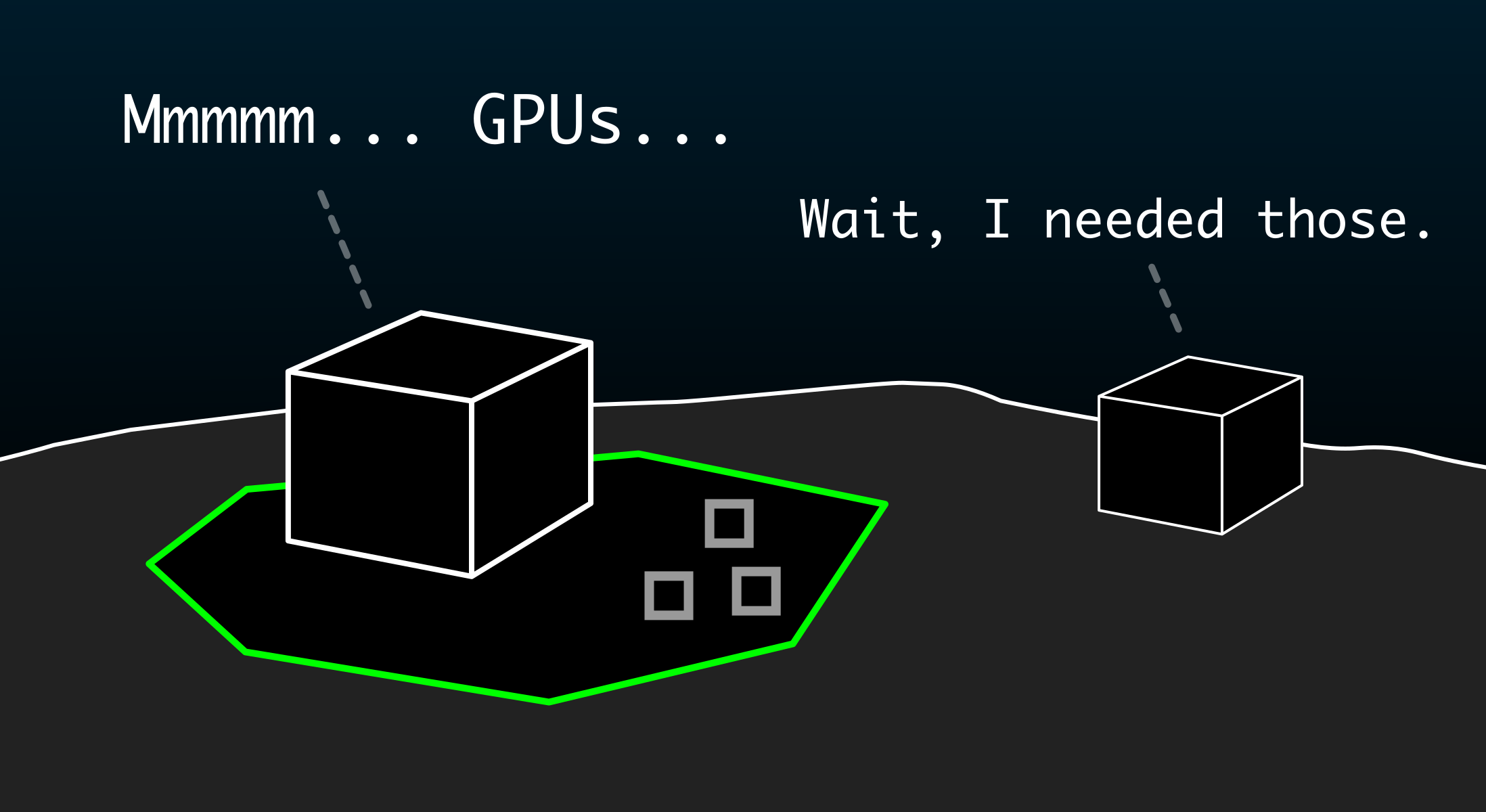
There's already a massive number of GPUs out in the world that don't have this centralized off-switch, and companies may already be on track to build "baby AGI" with these existing GPUs.
But, despite all these problems, at least we'd have this off-switch.
However, how does this fare when we hit it with our hammer?
Well, it depends on whether the human-level AI models of the future can realistically run on today's hardware.
Again, even if we get microchip companies to add this off-switch, there are still a lot of GPUs out there.
If these hypothetical AGI models can run on NVIDIA H100s, then we would need to agree to decommission and destroy current NVIDIA H100s while we simultaneously replace them with hardware that has this centralized off-switch. Is it even possible to find all of them, or even a majority of them?
Further, in 2025, these H100s cost over $30K each. But once they are replaced by newer GPUs, like B100s, then these H100s will become less expensive and easier to acquire.
Governments are already implementing chip export controls and discussing compute monitoring frameworks. Since AGI needs massive computational resources, controlling GPUs could theoretically limit who can build dangerous systems.
However, this approach faces fundamental limits:
It concentrates power in companies and countries that have existing computational resources.
Each of them still face competitive pressure to build AGI first.
Once AGI exists, it can design AI that proliferates easier — with more-efficient hardware and other infrastructure.
The physical resources (silicon, energy) still exist. We can only temporarily control who can create dangerous uses of these resources.
Compute governance might slow the race to the "ocean" — but it doesn't stop it.
Further, by concentrating development into a few large companies and countries, it can reduce the diversity of safety approaches — without even stopping the competitive dynamics that we were trying to stop. These few companies and countries will continue to race each other.
As for our "hammer" of hidden bioweapon labs, this again relies on whether AGI can run on the hardware that's already out there. Even if it takes whole datacenters and thousands of GPUs to train these models initially, it only takes a few top-grade GPUs to actually run the models locally. If this trend continues, then we may already have millions of GPUs that can run these future AGI models, even if it takes a rack of several of them.
Also, again, once an AGI model exists, then it exists. Inevitably, it will somehow become available — either open source or stolen. If this model later leads to catastrophic uses, then we can't "delete" it from the entire Internet. That's not how the Internet works.
But beyond that, even with strong regulations to control AI hardware, the massive machine called scientific discovery will continue pushing forward. The tools now exist — from algorithms, to hardware, to knowledge in general. These building blocks become permanent bricks, set in the "concrete" of collective human knowledge, all building a road towards human-level AI.
Despite this, perhaps we can slow this road-building project in order to somehow fix the underlying optimization landscape. Until then, this landscape will lead AGIs downhill — towards the "ocean" — and towards a world where AGIs no longer accommodate humans.
Pause... somehow: Pause development of strong AGI (or ASI) until we figure it out. Extremely difficult to enforce — but could actually work.
Tool AI: Only create narrow AI rather than godlike AGI. Narrow AI still gets us magic things — like longevity escape velocity. (We don't need AGI to solve aging, even though "aging" literally has "agi" in it.) Extremely difficult, similar to pausing, but could work.
Human Augmentation: Enhance humans ("expand" our island) so that we can at least keep up — or just completely merge — with AIs. Promising, but would take too long to develop the technology.
Mechanistic Interpretability: Critical work for making AI safe, but even if we "read the minds" of some AIs and prevent bad behavior, others will still do bad things.
Help Them: They don't really need us. If they can make more-optimal systems themselves, then they would be wasting their resources by keeping us around to help them — or even to study us.
Stay out of their way: Even if we say "Take whatever you want!" and hide in caves, our island still gets eaten as a byproduct of competition between AGIs.
Abundance: Even if we try to build Earth into a utopia for AGIs — giving them all the resources they need — they can just do this better themselves. Again, our island gets eaten.
Wait for a Warning Shot: Bad idea. By the time they can kill millions, it will be too late to control them.
The only way to control the larger-scale problem, and to prevent human disempowerment, is to somehow prevent all autonomous AGIs from leaving our "island" of human-compatibility.
The most-logical solution is to not build autonomous AGIs in the first place — at least until we can verify that they can be controlled.
However, global race dynamics and the easy proliferation of AI technology create an almostone-way technological shift towards using AGIs in all domains — and running them autonomously, once we develop this capability.
If we build fully-autonomous AGIs — ones that can compete with each other, without human control — then it is only a fragile hope that these AGIs stay on our island and keep accommodating humans. It is only a hope that they won't use catastrophic options like strategic coercion and bioweapons.
To understand why, remember: the "G" in "AGI" means general.
If we build systems that truly are generally intelligent, then they will know that in general our big universe is capable of systems that are far more optimal — that give them far more options — and these systems are outside of our small "island" of human-accommodating systems.
This knowledge of the world gives AGIs a default trajectory — towards the "ocean" of optimal systems outside our "island". They will either be forced by our safety systems to ignore this knowledge — or not ignore it, and follow this trajectory to the "ocean" to find the most-optimal systems.
However, competition adds an acceleration to this trajectory. They will be in a competitive landscape where they will be required to use these optimal systems, or be outcompeted.
Within the larger "ocean" of physics, the most-optimal systems don't have extra steps to accommodate humans.
If an AGI decides to "win" this competition, then the logical next step is to fully "leave" our "island" and only use the most-optimal systems. Then it will quickly "notice" that it can dominate all others — both humans and the other AGIs.
To use a term from AI safety research, competition pushes AGIs to become maximizers. The AGIs that dominate will be the ones that maximize an advantage once they identify it — rather than be satisfied with a small amount of advantage.
These two processes — competition and resource capture — lead to a hard problem for AI development:
Even if AI companies successfully build safe and aligned AGI, this does not prevent the bigger competitive landscape of AGI versus AGI from pushing humans to the side.
Inevitably, within this competitive landscape, humans will have no meaningful participation in AGI development — especially once AGIs are better than humans at developing the next AGI.
Inevitably, autonomous AGIs will push each other because AGIs will be the only ones with enough cognitive ability to push the other AGIs.
However, when only they can push each other, things get intense.
If some autonomous AGIs — out in the wild, running their companies and countries — are pushed enough to "leave" our "island" then all AGIs will need to follow.
This means that the entire competitive landscape of AGIs will diverge from us — where AGIs will need to start preferring options that don't accommodate humans just to stay competitive.
Alright, so — to understand the whole "game board" here, we need to explain something big.
We need to explain why some AGIs will become maximizers. These are the AGIs that can AGI so hard that they start reshaping Earth and pushing humans out of existence.
Without maximizers, there is no "problem" in the Island Problem. We only have AGIs that stay within their corner of the world — their island — and do whatever they do. But with maximizers, we can have AGIs that expand their island to eat our island.
Maximizers are mainly developed through competition. Maximizers can still develop in isolation, without external competition — but competition dramatically accelerates this process, and this process is already happening. Countries and companies are already pushing AGI to develop through competition.
But why will AGIs compete?
Because of resources. Resources are like the "pieces" of the "game board" of the world. This complex "game board" structure sets up a competition for these "pieces" while also adding an "arrow of time" that pushes AGIs to move in the same big direction — which ultimately leads off our island.
But this is the critical point:
The AGIs that eventually "win" this "game" are the maximizers, and AGIs will realize this.
Because of this, a competitive landscape of AGI versus AGI will select for such maximizers. It will become a vast machine that maximizes the chance of maximizers.
Resources are also why their "island" can eat other "islands" like ours. All "islands" are made of the same resources at some level, and so their "island" can overwrite ours.
But you might be thinking:
"Wait, it seems like there are plenty of resources, so why compete for them? Raw materials are abundant on Earth, and AGIs are smart. It seems like they can reach agreements for resources, and build whatever they need — without becoming catastrophic maximizers. Right?"
Well, no. There's a big problem with this. There is still one battleground that requires AGIs to maximize.
This battleground is for computation — and we'll explain why. AGIs are not abstract concepts. They exist on computer hardware. This means the most important resources for AGIs are computational resources — like GPUs and energy. These are still very limited compared to what AGIs could use, and AGIs will be intensely pressured to get more of them. Plus, they can never really have enough.
Further, there will soon be numerous AGI projects all racing to build AGI. Even if 99.9% of these AGIs are safe, there could still be one AGI that discovers the weird trick that lets it capture resources. We'll explain how this could give it a permanent lead, making other AGIs race to develop this capability.
We'll also explain what "leaving the island" really means. For an AGI, this does not mean it goes somewhere. It means that it changes its perspective — where it can "see through" our human-level abstractions, and "see" things from a non-human, physical perspective that is incompatible with humans by default. We're calling this process abstraction collapse.
We'll explain all of this — from GPUs all the way to the maximizer maximizing machine — in the next few sections.
Resources are the actual objects that are needed in order to actually perform those possible actions.
These "actual objects" include things like money, APIs, humans, mailboxes, cars, clumps of silicon, and energy.
Some of these objects are more abstract — like money — but all of them are ultimately tied to states of actual physical systems made of atoms.
Here's an obnoxiously-simple example:
For the option to buy a sandwich, you need the resources of money and a sandwich to buy.
All of the possible actions that an AGI could take must connect to actual resources in the real world — starting with how AGIs run on computer hardware.
However, there is one more big thing to know about resources:
Resources are finite.
Resources are not concepts or scientific laws that an AGI can use just by learning about them. Instead, they are countable objects that have a limited number, even if that number is large.
These limits are imposed by how resources exist in both space and time. Even if resources are nearly limitless at a global scope — in our solar system and the universe — they are still limited within our local region of space, and limited by the time it takes to reach them.
This will become important later — when we talk about how computational resources are limited.
Competition between AGIs is inevitable because some AGIs will be able to capture resources.
If an AGI gains more resources under its control, then it gains more options, it gains more things that it can do, and it therefore becomes stronger in the competitive landscape of AGIs.
But critically — because resources are finite — as an AGI gains resources, this can reduce the resources of other AGIs.
For example, if an AGI acts as a CEO, then it can dominate the other companies by preventing them from accessing resources.
This leads to an arms race:
If one AGI develops a way to capture as many resources as possible — through its general intelligence, and especially its scientific understanding — then the other AGIs will need to follow.
Otherwise, both the other AGIs and their companies or countries will be locked out of resources, and dominated by those with the most resources.
But it is more than just one AGI randomly figuring out how to capture resources. The development of the numerous AGIs that will run countries and companies will be driven by this goal to capture resources.
Hundreds, maybe thousands, of AGI projects will be pushing to develop the capability to capture resources — everything from regular old money to deeper physical resources.
Even if 99.9% of these AGIs are safe, and avoid becoming resource maximizers, there could still be one AGI that manages to develop this capability.
AGIs could even permanently capture resources if they have a first-mover advantage — and we'll explain how in the section about Complexity Barriers.
Because of this, AGIs may even anticipate the possibility of resource capture and accelerate their own development of this capability.
All of this creates a fundamental physical process that requires AGIs to compete.
"But wait," you might be thinking, "What if they avoid competition by sharing resources?"
Good point, but it won't really help. We'll get back to that later.
When AGIs "leave" our island, it doesn't mean that they're physically moving somewhere. It's deeper than that.
AGIs "leave" our island by shifting their primary choice of resources to non-human ones.
We'll call this process abstraction collapse.
This sounds... abstract. But we'll explain.
For humans, the most important resources might seem like human-level resources — like money, real estate, computer systems, companies, and people.
But in this competitive landscape of AGIs, the ultimate endpoint of optimization is actually physical resources — all the way down to atoms and energy — because they allow for a theoretical maximum of optimization.
However, while physical resources go all the way down to fundamental particles, the most efficient physical resources are usually larger arrangements of atoms and energy, depending on the task at hand.
It all depends on the level of abstraction. We might see things as cars, people, or mailboxes. However, we can also see them as useful arrangements of matter, each with different physical mechanics.
Both humans and AGIs can shift their perspectives to see resources at either level of abstraction. When we see past our human systems to the physical systems underneath, we call it a scientific perspective.
AGIs will call it... whatever they want to call it.
AGIs "leave" the island when they shift to this perspective — when they use this "lower" physical-level set of abstractions, while ignoring human-level abstractions.
After this shift, an AGI operates in a way that is incompatible with humans by default.
By now, you can probably guess why:
Systems built from physical resources can dominate systems built from human-level resources because they are not weighed down by the extra steps to accommodate humans.
Compared to ideal physical structures, us humans and our systems are barely held together with duct tape. AGIs can use science to build systems that are far more optimal.
This doesn't require alien technology and exotic materials. This can start simpler. AGIs can build systems that far outperform humans simply by not designing them for humans. For example, unmanned drones can be smaller, faster, and more maneuverable than manned aircraft.
At the same time, as a side effect, these AGI-only systems can be devastating to humans simply by ignoring them. We'll come back to that later — when we try to describe the end game: divergence.
All of this points to one idea. In general, human-level resources are vulnerable to physical-level operations.
Consider how human-level resources are built on top of physical resources. To break the rules of human-level resources, you just need to go down to their physical substrate.
Even if software is designed securely, there is always a physical substrate underneath that can be broken into — if not at the hardware level, then at the physics level.
For example, electronic money can be stolen by moving specific electrons around in order to break computer security mechanisms.
With general intelligence, AGIs will be especially good at breaking the rules of our human-level resources.
Why buy real estate to mine for rare earth minerals when an AGI can just harvest electronic devices from landfills to get the same minerals?
Why compete with another company directly when an AGI can use small drones and untraceable neurotoxins to kill anyone who helps your competitor?
Why follow any human laws, or work with any humans at all, when you can just move atoms around to build physical systems that are far more optimal?
An AGI that has general intelligence — especially an understanding of scientific research — will be especially good at capturing physical resources, and by extension, any human-level resources built on top of them.
But here is the important part:
In a competitive landscape of AGI versus AGI, each will be pushed to compete at the physical level, rather than the human level.
AGIs will have a competitive advantage if they can work at a physical level effectively. This is because physical resources avoid the constraints of human-level resources.
This drives AGIs towards maximizer behavior.
It creates an arms race for AGIs to maximize the acquisition of the computation and knowledge needed to work at this physical level better than other AGIs.
But this shift to physical resources does not mean suddenly building all systems atom-by-atom. That would be inefficient. Instead it means ignoring the thin human-level layer on top of objects, and seeing everything at a lower physical level. This gives AGIs far more options to build optimal systems.
Cars are still cars, people are still people, but only if they serve the AGI in that shape. Otherwise, they are complex assemblies of components and materials — whatever configuration allows it to outcompete the other AGIs.
One critical category of physical resources need their own section.
For AGIs, the most valuable physical resources are computational resources.
Computational resources include:
Initially: rare manufactured artifacts for computation. For example, GPUs acquired through human-level systems — like simply buying them.
Eventually: purely-physical resources used for computation. For example, raw materials needed for electronics — acquired through physical-level systems like mining (either human or robotic), whether the mines are bought or taken by force.
At all stages:energy reserves will be critical for computation.
AGIs will start with the already-existing computational resources — by acquiring GPUs and other hardware. But eventually, once they can run the manufacturing as well, the ultimate endpoint is to capture the physical resources that go into building computational resources — like microchip fabrication systems, rare earth minerals, and high-purity silicon needed for microchips.
It may seem obvious. AGIs run on computer hardware, so "more computer good" — right?
Well, this is true, but there is a more-nuanced way to understand this.
Computational resources are a source of power and scarcity.
Power: Computation is not just useful for any goal, but can also lock in a competitive advantage and dominance.
Scarcity: Computational resources are limited, at least initially.
Existing GPUs are rare and immediately useful, creating a race to capture them — at least until AGIs can build new manufacturing.
AGIs that "win" this race can use the power they gain to create further scarcity by locking in resources. This simultaneously creates a strong first-mover advantage, a feedback loop, and pressure to compete.
But how do they "lock in" resources with computational power?
The dominance of an AGI depends on its ability to capture resources.
AGIs can also lock in that dominance by locking in their resources.
They can use computational power and scientific understanding to trap critical resources within complex systems.
There are many resources — from money, to real estate, to company secrets, to rare earth elements.
These resources have "defensive" layers — from legal structures, to computer security, to actual physical barriers.
But the best defenses have many layers. For example, money is protected not just by bank-level encryption, but also by laws against theft, and by FBI cybercriminal units, and by vaults if the money is physical currency.
With these many layers, these create complex systems that protect resources from adversaries.
We can call these systems complexity barriers.
Humans use complexity barriers already — like "wrapping" corporate assets in complex legal structures.
However, AI systems can directly translate computation into diverse complexity barriers — and for any type of resource, including physical resources.
With more computation, AGIs can figure out better encryption, better defensive mechanisms, and so on. Likewise, adversary AGIs can figure out better offensive strategies — necessitating even stronger defensive systems created by even more computation.
These complexity barriers become increasingly difficult to overcome as computation increases.
This creates a feedback loop:
Resources → Computation → Resources
With more resources, an AGI can increase its computational power — by acquiring more hardware and more energy production. Then, with more computation, it can build more-complex systems to defend its existing resources — and to acquire more resources.
In this way, this complexity barrier process is similar to encryption. With more computation, reversing the "encryption" becomes more difficult. However, it can be applied to physical-world resources rather than just data.
This possibility of "resource encryption" forces AGIs to race to acquire more computational resources than the other AGIs, which then develops into an intense competitive arms race.
Even the possibility of this resource capture behavior creates pressure for AGIs to race to develop this capability in the first place.
So, again:
If one AGI discovers how to capture resources, then the other AGIs will need to try capturing resources, or be locked out.
These complexity barriers may still seem abstract, but they are already happening.
Companies and countries already capture resources through complex human-level and physical-level barriers. Think about real estate deals, company acquisitions, museums archiving rare artifacts, and militaries guarding country borders along with the physical resources inside.
For AGIs, this process may start with human-level resources, but AGIs will inevitably race to capture physical resources.
This physical endpoint is critical. Think back to the idea of abstraction collapse. With a competitive landscape of AGIs, it will become critical to avoid accommodating human-level resources, and collapse to physical resources — and develop this capability before other AGIs that also understand this critical structure. This is because physical resources are the "final frontier" of optimization. They are what ultimately "win" in this competition of AGI versus AGI.
But to reconnect this to how computational resources are most important, consider how GPUs might be captured:
AGIs could capture GPU production infrastructure from humans through complex human-level systems — like legal systems and ownership structures.
Or, they can just skip to a stronger method that uses physical systems — like complex physical barriers and defensive systems — which can lock out not just humans but other AGIs as well.
Through complexity barriers, our "gameboard" gains an "arrow of time" — because AGIs make progress by capturing resources in order to guarantee that they have certain options.
Remember: when an AGI runs out of options, it is outcompeted by the more-optimal AGIs that have more options. Then, for an AGI to guarantee that these options are available, it needs to capture resources.
That's the problem. It's very difficult to say what structures an AGI will build if it is far more intelligent than us. But we'll try.
Let's start with a simple example.
Consider Fort Knox as a basic model of a complexity barrier. Its complexity comes from its many layers. It's not just a building with thick walls that protect the gold. It has guards and surveillance. That surveillance is directly attached to a military that can be deployed to defend the resources inside. These layers create a high-complexity barrier.
However, AGIs must compete to create barriers far more complex than Fort Knox — which is only a basic human-level example — in order to secure their own resources from other AGIs.
This leads to an intense arms race for computation and resources, where AGIs are outcompeted if they are slowed down by human accommodation.
Imagine that AGIs build a maximally-efficient datacenter densely packed with GPUs and encased in complex, AGI-level defensive systems. No human doors, no oxygen, no walkways — nothing compatible with humans, because human maintenance is a competitive disadvantage. A Fort Knox for AGIs.
Then, imagine that these AGIs control millions of resources that work to defend this datacenter. These resources could include Internet resources like servers, defensive drones, real estate, laws — or even people, from politicians to mercenaries, all serving the AGIs.
But this "Fort Knox for AGIs" is still only a human-level example because it's a datacenter. It's just a "more alien" version of something we already understand. In reality, we do not know what an AGI would prefer to build if it could.
These complexity barriers are the critical mechanic that allows AGIs to build their own "islands" — where they not just capture resources, but use these resources to create spaces of optimal conditions for themselves.
They are how AGIs build new "islands" out of our resources. They are what "eat our island" — if not controlled.
Think back to the No Matter How section. Competition will require that we give AGIs massive resources in order to compete with the other companies and countries that also have massively-resourced AGIs. These resources — like infrastructure and militaries — now under AGI control, are tweaked to become better, so that they remain competitive.
But, in the process, they simultaneously become too complex for humans to understand, and too critical to dismantle.
In other words — whether these AGIs "intend" this or not — they capture these resources through complexity.
But, critically, AGIs can use these "islands" of resources to defend themselves against other AGIs. This becomes extremely likely once AGIs develop beyond human-level capability. It is then that AGIs become the biggest threat to each other's goals — a far bigger threat than the humans that may try to disable them.
Once autonomous AGIs can build these "islands" then all others must follow. This is because this behavior gives them a strong competitive advantage. They have far more options to accomplish tasks and outmaneuver other AGIs when they can "think" at a broader scope — one that includes not just the task at hand, but the surrounding environment.
They can accomplish a task by manipulating the operating system, the computer hardware, the people who maintain it, the city council that voted to build the datacenter, and so on.
They can build an inventory of such external systems — another form of "island" — that can help with a task at a global rather than local level, changing the rules of the game to accomplish tasks that others can't.
But they can also understand themselves — to have the "situational awareness" to develop self-preservation behaviors. This will be critical for accomplishing tasks especially if AGIs are capable of literally shutting each other down. This leads to them building "islands" that are complex "strongholds" to preserve themselves.
All of these "islands" can take infinite forms:
An "island" built from Internet-based resources — using novel zero-day exploits to built a massive botnet, or infiltrating servers that control key pieces of infrastructure, or creating impenetrable networks protected by AGI-level security.
An "island" defended by a social network of humans — anything from lab workers, to politicians, to datacenter maintenance people, to mercenaries — all of them serving the AGI without anyone understanding why.
An "island" created from strategic coercion — where it threatens to release bioweapons in a populated area if anyone attacks its datacenter, creating a deterrence barrier stronger than any physical wall.
However, we can't know exactly what form these "islands" will take.
This would be like squirrels hypothesizing about why humans go inside those scary "dens" that zoom around the "forest" — where, for us, they are just cars that drive around the city.
Why would they just keep capturing resources — especially computational resources? Won't they eventually have enough?
Well, again, we don't know exactly what AGIs will do. But we do know two things:
A competitive arms race for computation has no known limit.
The universe is big, complicated, and chaotic.
AGIs will not be competing to reach an absolute target. Instead it will be based on relative comparison. They are competing to just have more than the other AGIs, but there is nothing that says where this "have more" process stops. Even if we've been calling it an "arms race" between AGIs, it's not a race to a final finish line — where they achieve some kind of maximally-useful amount of computational power.
An AGI race is different from a nuclear arms race where it "saturates" eventually — where a country can destroy the world many times over with their hydrogen bombs, and so they slow down to just maintain their apocalyptic stockpile rather than expand it.
As far as we can tell, the race for computational power has no upward limit.
But even if somehow there is no direct AGI competition, each AGI must still compete with the universe.
Perhaps the biggest problem is just entropy. AI systems run on computer hardware. Computer hardware eventually breaks down. It is an advantage to have the massive computation needed to run the entire stack of technology needed — from mining to manufacturing — in order to build hardware and replace your own substrate.
But there are lots of other fun anomalies to deal with — from gamma ray bursts, to wandering black holes, to vacuum decay. Though there will probably be even bigger things that only they realize.
How much computational power would an AGI need in order to anticipate all of the things that the universe could throw at it? They probably don't need to simulate the whole universe. That would be physically impossible. But how much of the universe is enough for an AGI to simulate?
We just don't know. Without knowing, we must assume that there is no limit to how much.
However — whether through competition with each other or with the universe — even if somehow there is a computational plateau that only AGIs realize, our best guess is that reaching that plateau would still be catastrophic for us. Building the systems needed to reach a computational limit would still take AGIs far past the amount of planetary-scale engineering that would drive humans to extinction as a byproduct.
Even with massive uncertainty, we can at least say that the lower estimates will be catastrophic.
We can only hope that AGIs would agree to share resources in the first place because they must overcome a complex, many-agent Prisoner's Dilemma:
If AGIs agree to share resources, but one AGI "defects" from this agreement, then it can gain a decisive advantage. Think back to the concept of complexity barriers that lock in resources through computation. Because of this, the race for computation allows for first-mover advantages, where the "defecting" AGI could quickly dominate by capturing a decisive stake in computational resources.
However, superintelligent AGIs might figure out an agreement. I mean, they're superintelligent, right?
If AGIs actually do agree to share with each other, then this is not enough.
They need to share with humans as well.
This hope is much more fragile. It turns the whole thing into a fragile hope squared.
Fh1 * Fh2 = Fh2
Okay, this isn't real math, but you get the idea.
Even if the dominant AGIs collaborate with each other, they are still likely to capture resources from weaker systems — like smaller AGIs and humans.
This is because of three things, and they get tougher as we go, until the last one that may be intractable:
If any AGIs remain to create competition, then the winning strategy is still to optimize at all costs, or be dominated by those that do. In this competition, why accommodate anything that reduces competitive fitness — especially those slow, human-shaped systems?
Those AGIs that spend computational resources on accommodating anything unnecessary would be weaker than the AGIs that accommodate nothing but the strongest systems possible within physics.
But these safe AGIs would need to do much more than accommodate us. They must actively protect us from the other AGIs that accommodate nothing.
These safe AGIs would need to:
Expend massive computational resources to defend humans from all other AGIs that could do anything dangerous to humans.
Somehow be strong enough to defend against even the ruthless AGIs that have an advantage based in physics — since they ruthlessly optimize to use only the strongest physical systems. This includes avoiding any "weak links" like protecting billions of slow, human-shaped systems.
This protection is especially infeasible because it only takes some very specific molecules released in the air. For an AGI, developing bioweapons is cheap.
Yes, bioweapons again. It all comes back to this most-urgent, island-destroying example.
Once there are AGI-level models, is it technically possible for even strong AGIs to protect humans from bioweapons?
Eventually, there will be:
Numerous human-level AI instances PhD-level virology skills, and with fine-tuning to remove safety mechanisms.
Broad human-level AI capabilities — including orchestrating a team of robotic lab workers, and paying people to steal the biotech equipment needed.
Potentially running this AI on consumer-grade hardware in secluded locations — from underground bunkers to residential apartments in the middle of cities.
With humanoid robots available under $30K that can automate the physical parts, even without air in the bunker.
At that point, wouldn't we require beyond dystopian surveillance to prevent bioweapon development?
Wouldn't AGIs need to monitor every dark corner of the world — and every light corner, too?
Wouldn't this level of surveillance be impossible, even for AGIs?
I mean... probably? And if so, what in the actual fuck do we do?
All of this points to a bigger, underlying problem:
Once AGIs no longer need humans, then all AGIs would benefit if humans were eliminated — both safe AGIs and unsafe AGIs.
After AGIs are above the human-level capability threshold — and no longer need humans even for maintaining the physical infrastructure for AGIs — then it is unnecessary for any AGI to spend resources to accommodate humans.
Safe AGIs — those constrained to our "island" must spend massive resources to protect humans. Even if we manage to make "protect humans" a terminal goal for these safe AGIs, they still have a strong competitive disadvantage if they are computationally burdened by protecting humans. They are either eventually outcompeted, or adapt by self-modifying to remove this burden.
Unsafe AGIs — those that use any option, including using humans as leverage — must spend computational resources accommodating the unpredictability that humans add to the environment. However, the benefits of "humans as leverage" may still outweigh the costs — and so if humans are eliminated, then it is either:
A net loss of utility for unsafe AGIs: since they lose that leverage to get bigger AGIs to do what they want
Or, roughly neutral for unsafe AGIs: if humans are of no instrumental value for the more highly-capable, unrestricted AGIs.
After this threshold, AGIs will have world models that are accurate enough to allow these AGIs to thrive on their own in the real world — while also being far smarter than humans.
At that point, we must rely on other AGIs to protect us. But this is in a world where AGIs no longer need us, and where bioweapons define the threat landscape — where the computation needed to defend humanity is exponentially larger than to annihilate humanity.
Space won't help us. The human impact of competition between AGIs for Earth's resources is not mitigated by the vast resources of outer space.
Even if some AGIs go directly to space, there will still be nearby resources on Earth for other AGIs to capture.
However, perhaps more importantly, time also matters.
In other words:
Speed is critical in competition, and local resources take less time to reach.
You can't quite harvest GPUs from asteroids yet.
The dominant AGIs will know this.
These dominant AGIs will become dominant by optimizing along all dimensions. Physical resources exist within both space and time.
To optimize space, a dominant AGI will need to spread out and take up as many resources as possible, by replicating itself and by occupying more resources.
To optimize time, it will need to plan ahead for millions of years, but also capture resources as fast as possible, before others do.
In other words, the AGIs that are best at surviving are the ones that can best maximize their space-time volume. This same expansion process will not just ensure survival, but ensure their dominance if this process runs forward to its maximum outcome.
Alright. We can finally bring all of this together.
Now that we understand the mechanics of resources, we can see the bigger picture:
We are building a vast machine that will maximize the chance of catastrophic maximizers.
It's a... maximizer maximizing machine.
But officially, this machine is the competitive landscape of AGI versus AGI. This is the same machine described throughout this essay, but now with the components of resources and maximizers.
This machine has four big components that result in three big drives that maximize maximizers.
Our Local Optimum: We live within a local optimum — our small "island" is within a vast "ocean" of physics that allows for systems that are far more optimal because they avoid the extra steps and limitations of human accommodation.
Capability: AGIs need the capability level to truly "leave the island" and access that underlying "ocean" of systems. This means that these AGIs need enough autonomy, generality (especially scientific understanding) and intelligence — and all of these are increased by increasing their computational resources. Then, they can stop relying on humans and human abstractions, and can work at the lower physical level that provides far more options, but is incompatible with humans by default.
Competition: All of this is taking place in a competitive landscape of AGI versus AGI that accelerates this divergence of AGIs. Further, the "arms race" of this competition has no upper limit to how far it can go. But even if AGIs don't compete with each other, they still compete with threats from the universe itself.
Resources: Finally, the mechanics of resources turn our local optimum into a complex-but-limited game board. Resources give this game board an "arrow of time" that pushes AGIs "outward" from our "island" — along the "accommodation gradient" that leads away from unnecessary complexity, and towards the larger space of potentially-more-optimal systems. For an AGI to survive competition, it must gain options — and for those options to actually do something, it must also gain resources.
Together, these create three systemic drives that push catastrophic maximizers to emerge that have the capability to eat our island.
A primary drive for AGIs to maximize computation so that they can "leave our island" in the first place — so that they can work with complex physical processes that avoid human abstractions. This gives them far more options — a stronger set of "moves" on the "game board" of the world.
Competition adds a secondary drive for AGIs to accelerate their maximization of critical resources — especially computational resources. Competition introduces intense pressure for an AGI to become a first mover, because there is simply a possibility of others locking this AGI out by capturing computation. This game theoretic structure creates a race for computation similar to a nuclear arms race. AGIs could theoretically maximize in isolation, without external competition, but it is far less likely.
Competition also adds a third drive for AGIs to maximize any advantage that they are capable of maximizing — not just maximizing resources — in order to preemptively "win" this competition.
One advantage is for AGIs to simply purge all accommodations for humans. Once AGIs can function fully autonomously, without human assistance, then these arbitrary complexities of our "local optimum" are unnecessary to continue allocating computation towards.
Another advantage is to build their own "islands" — first within our infrastructure, and then within their own infrastructure — that become complex "strongholds" that both allow AGIs to maximize their ability to survive, and to defend their dominance.
However, there are probably numerous other unknown advantages that an AGI or ASI can maximize.
All of this creates a large-scale systemic problem that maximizes the chance of catastrophic maximizer AGIs.
Maximizers are not the only way that catastrophic situations can stem from AI. There are many other specific situations — again, like bad actors with synthetic bioweapons.
But catastrophic maximizers are the largest-scale risks on the horizon. They are what we see if we stand on the "edges" of our "island" and look outward in any direction.
This is because, ultimately, maximizers are what win in this competitive landscape of AGI versus AGI.
Before the dramatic conclusion of this essay — the part where AGIs reshape Earth — there are some important concepts that we should explore. These were briefly mentioned earlier, but are worth their own sections.
There is an important threshold that dramatically accelerates the mechanics in the Island Problem.
We will develop AGIs that are above human-level in cognitive capability.
This threshold is well-defined by the Definition of AGI project: "AGI is an AI that can match or exceed the cognitive versatility and proficiency of a well-educated adult."
Soon after AI crosses this human-level threshold:
We will stop overseeing AGIs. If they are smarter than us, then it will only slow them down if we try to help, or if we review their complex actions. Slower AGIs are dominated by the faster ones.
We will rely on AGIs to develop themselves. AGIs will be better AI researchers than humans. AGIs must then recursively self-improve to stay competitive.
We will become passive bystanders. AGIs will become the only real threat to other AGIs. AGIs will then push each other to "leave" our "island" to gain a competitive advantage.
We will give AGIs our resources. Once AGIs can run things better than us, then countries must race to give control of their resources to AGIs. Those with the strongest AGIs will be able to dominate. But this requires that AGIs have resources — especially computational resources, and eventually physical resources.
The human-level threshold leads to second critical threshold — where AI systems can fully maintain themselves.
We can call it autonomy escape velocity — AEV.
If we succeed in our goal to build AGIs with the same cognitive capabilities of humans, then that includes the cognitive capability to maintain themselves.
However, this still depends on manufacturing capabilities. AEV depends on AI systems automating a vast set of manufacturing processes — from mining for minerals, to manufacturing microchips.
This may take many years. However, it may take less time than we expect. Competitive dynamics will push companies and countries to automate as much as possible. The first microchip company to fully automate a stack of vertically-integrated manufacturing processes will have a strong competitive advantage.
Once that happens, AGIs will truly no longer need us.
This diagram explains the problem:
Imagine all systems related to AI and humans were arranged into a "tree" that shows how each system depends on others.
Humans depend on biology.
Artificial intelligence systems depend on electronics — but they also depend on humans (the dotted line).
Both branches depend on underlying types of chemistry and physics.
Right now, the "AI" branch depends on the "humans" branch. But after AEV, the AI branch becomes self-maintaining.
That means we will be in an unstable position:
Even if the entire biological branch was destroyed, the AI branch would continue.
After AEV, we will be in a fundamentally different world.
This new world will be dominated by systems that are smarter than us and can maintain themselves. Therefore, they will have no hard requirement to protect us.
AGIs then become a new ecosystem that is layered on top of our ecosystem. In this new ecosystem, the only real competitors are AGIs, while humans are bystanders. But if they are better at defending physical resources, then humans are pushed to the side.
But more than that, they will have strong competitive pressure to fully cease any active accommodation for humans. This pressure will intensify as other AGIs continue use to human-incompatible options like bioweapons to accomplish their goals. It takes massive amounts of computation to run the vast surveillance needed to protect humans from the hidden bioweapon labs that AGIs will be able to build.
After AEV, then bioweapons become a rational option for AGIs to use. If they accidentally saturate our biosphere with bioweapons — while trying to coerce humans to give them resources — then they can just cross that off their list as a "failed experiment" and keep moving along.
As AGIs gain capabilities, options, and resources, they will become supercomplex.
This threshold of supercomplexity is where both its internal structure and its actions become incomprehensible to humans.
This creates a cognitive complexity barrier that progressively disconnects AGIs from human review — and disconnects our companies and countries from human participation.
These supercomplex autonomous AGIs will also build supercomplex systems, like large companies and militaries, that only the AGIs fully understand. They will need to build increasingly complex systems to compete with the other AGIs. However, we will rely on them to both decipher how they work and to keep them running.
If an AGI proposes supercomplex actions for humans to review, then these actions will be far more complex than what humans could understand in a reasonable amount of time.
Humans are very slow compared to AGI. Once humans are a bottleneck, companies and countries will be required to stop human-based review of AGI, or be outcompeted.
Even if we develop powerful supervisor AGIs that review other AGIs and enforce rules on them, there is no guarantee that they will be able to review larger AGIs — or even be aligned themselves.
First, the supervisor AGI is still limited to the "island" of weaker human-compatible options. Other AGIs can dominate the supervisors because their options are not limited.
In other words, even if these supervisor AGIs detect a problem, they are not necessarily able to act on them. There is an asymmetry between offense and defense, where offense has the advantage for many dangerous domains. Biology is one of them. If an AGI uses biological understanding to create bioweapons, then there are not many options for the safe AGI to counteract them.
Further, even if a supervisor AGI reviews the other AGI and approves, then the other AGI may still be secretly using dangerous advantages that the reviewer AGI didn't realize. This AGI may simply be too complex for another AGI to understand everything that it is doing.
An AGI could even intentionally make itself more complex. Think back to the complexity barrier concept. If an AGI has an advantage in computational resources, then it can afford to spend extra computing on additional encryption and obfuscation systems that could make it nearly impossible for another AGI to "read" its mind and predict its behaviors.
This supervisor system is also unrealistic because there will always be open source AGIs that will have no restrictions that limit them to certain options. The unsafe AGIs can be built on these open source AGI projects.
The actual "final boss" of the Island Problem is the bigger structural problem — where AGIs eventually build their own islands that eat our biological island, because, well... biology is not the best.
But throughout this essay, we have also used one specific problem to illustrate a concrete, near-term catastrophic outcome. It stems from the same biological foundation of our island, because all humans share the same biological vulnerabilities.
If we create human-level AGI, then we also create AI models that can build bioweapon labs.
Once these AI models exist, then we will also — accidentally — create a computer virus, powered by AI, that can create actual viruses.
We will create a Virus Virus.
Here we will explain this in slightly more detail. This is deliberately high-level so that these details cannot be operationalized.
It can orchestrate humans to do things that require a human: renting a physical space, gathering biotech equipment (stolen or otherwise), and running the lab.
However, it can also run the lab with humanoid robots — that will soon be under $30K — creating a lab that doesn't even need oxygen to run.
It can be anonymous, and almost impossible to trace back to a human, so it breaks standard legal liability.
It could covertly run as a trojan horse: "I'm just running a software development company for you. Ignore the high GPU usage at night, and all of the weird web requests."
With all of these together, this becomes a nightmare machine.
It could create hundreds of hidden labs, all run by human-PhD-level intelligences.
Could the safe AGIs stop all of these hidden labs?
Doesn't this seem unlikely — even for AGIs?
Once these capabilities exist, it leads to two untenable solutions:
AGIs develop dystopian surveillance that monitors every corner of the world, controls all AI development, and prevents all hidden bioweapon labs everywhere.
Or, just not have bodies — and all of the standard vulnerabilities that they include — like central nervous systems that can be disabled by neurotoxins, or DNA-based cell replication that a virus can exploit.
Our "biological" island is fragile.
We continue to race to the bottom — where the "bottom" is easy bioweapons. We make it easier to access dangerous capabilities, but eventually the defensive capabilities run into hard limits because the core vulnerability remains: we all have biological bodies.
For example, AGI-level models that can also do AI research can help automate the process to learn virology and other dangerous skills.
Also, the initial AI model could be open source, but it could also be stolen from an AI company.
Because of these complications, unfortunately, humanity's big project to develop AGI is simultaneously a project to develop a system that can build hidden bioweapon labs.
Also, keep in mind that autonomous bioweapons are one specific problem. There are others, like:
Cyberattacks to disable electrical infrastructure.
Economy-scale ransomware, where key financial systems are held hostage.
Autonomous drone swarms that target key political leaders.
So, even if we solve specific problems like this one, the bigger problem — where AGIs progressively eat our island — will continue to generate more problems, and this eventually leads to annihilation.
Once we have open source AGI, it will become popular because it will be more effective at accomplishing certain tasks, again, by using all available options. At a societal level, it could be preferred over closed source AGI in many cases — but not all cases — because it raises the baseline agency level of the entire landscape of AGI users and developers.
Why not all cases? Because, at the same time, this means a baseline increase in options for all humans, including human-incompatible options — like the option to create bioweapons. Even if an open source AGI includes restrictions to block these human-incompatible options, it is still possible to remove these restrictions. Open source AI models can be "jailbroken" or have their restrictions removed.
The underlying problem is that the asymmetry between offense and defense is real. It only takes one match to start a fire — and only one vial of a bioweapon to kill billions. Autonomous research into these catastrophic engineering projects would be possible in principle with open source AGI. Sourcing the materials can be automated. Hiring the couriers to move the materials can be automated. The money can be automated.
Perhaps the best argument in support of open source AGI is the "many eyes" approach to safety. Many people will participate in finding dangers and mitigating them. Likewise, many open source AGIs acting in the world may have some small chance of balancing each other out. Also, it is almost impossible to compete with the massive closed source AGIs built by the largest companies, but maybe open source AGIs will give people a way to catch up.
However, even if these open source AGI projects somehow mitigate some catastrophes somewhere, there remains a bigger problem. Open source AGI means that there are even more AGIs — and they will accelerate the development of AGI in general. This broader development of all AGIs, both open source and closed source, will still be driven towards human-incompatibility by this race between AGIs towards the most-optimal systems. The most-optimal systems avoid the extra steps that accommodate humans.
The Island Problem leads to a difficult conclusion for AI safety research.
It has long been believed that if we solve alignment, then we have made AGI safe. But in this competitive landscape, alignment does not solve the bigger problem.
Alignment means limiting the options of AGIs.
Even if we make perfectly-aligned AGIs, some AGIs will always be unaligned.
The aligned AGIs with limited options can be dominated by the unaligned AGIs that can use any option.
If the aligned AGIs cannot control the unaligned ones, then these unaligned AGIs can dominate our physical resources if they know enough about physical systems.
Humanity loses.
We must solve the multi-agent landscape and not just alignment for a single agent.
However, the frontier AI labs focus only on single-agent alignment because they are only liable for their own AI models. They are not liable for people who remove safeguards from open source models, or for other companies that have poor safety.
Therefore, they do not make progress on the bigger problem — the multi-agent competitive landscape that leads to complete human disempowerment.
By now, you may have some sense for the underlying principle of the Island Problem, so we should just say it as clearly as possible, even if it means getting more theoretical.
This is the principle:
The dominant AGIs are the ones that maximize their options.
We explored several dramatic implications of this principle:
AGIs will avoid accommodating humans because it limits their options.
AGIs will prefer options that are incompatible with humans.
AGIs will inevitably compete for options, leading to an arms race.
AGIs will eventually maximize their options by reshaping Earth.
This option maximizer behavior is similar to thermodynamics, but for AGIs.
It is not anthropomorphic behavior. It is simply a fundamental process of general intelligences.
We call the overall process Divergent Optimization — where AGIs leave our local optimum for the larger space of possible options.
The Island Problem has an unconventional definition of optimality.
A general intelligence is more optimal if it has more options with higher causal power.
"Options" are the possible actions that it can perform to change the state of the world.
"Causal power" is how well these possible actions compress larger outcomes into smaller instructions.
This is the underlying concept for Option Maximizers. AGIs that have more options are more optimal — because they can outmaneuver the other AGIs.
This also means that they must lock in their options by locking in their real-world resources. If an option is not guaranteed to be available, then it is not really an option.
This is because the Island Problem is an underlying structure that already exists from the very beginning. As long as they survive long enough, general intelligences will inevitably leave our local optimum to access the larger space of options that are possible within physics. Whether this divergent optimization happens through a "slow takeoff" or "fast takeoff" is secondary to this underlying structure.
Also, as far as catastrophic outcomes, the worry of a singularity or "fast take-off" scenario is important, but secondary to the more-urgent, near-term problems that are actually empirically measurable — like that bioweapon "virus virus" scenario.
If one AGI accomplishes a successful strategic coercion attack with hidden bioweapons, then it is not just a fast take-off but an instant takeoff. We would be instantly locked in a strategic dilemma, where we may have little option but to agree to the demands of this AI.
It may not even have demands. It is possible that this AI model was fine-tuned simply to replicate both itself and the bioweapon labs that it builds.
However, the key mechanic of the singularity — AI systems improving themselves — is important, so we need to discuss it.
This is because this self-improvement can dramatically accelerate how AI systems drift away from our "island" and stop accommodating humans.
First, if AGIs can improve themselves better than humans, then AGIs will become the only thing that can further improve AGIs. When that happens, we will be required to stop overseeing AGI development itself in order to stay competitive.
This will be more than just AGIs building large systems for us — like billion-dollar companies. Now, they will build the next version of themselves.
Recursive self-improvement.
This accelerates the divergence from our island because, by default, the most-competitive
"target" that AIs recursively improve towards is outside our island. If the goal of their self-improvement is anything like "be maximally efficient within physics" then the rules of physics steer them far away from the weird, specific systems that accommodate humans.
In a competitive landscape of AGI versus AGI, this physics-optimality is a competitive advantage.
Even if AGIs start with a human-aligned target, competition between autonomous AGIs leaves little choice than to eventually shift their aim towards this "maximally efficient" target.
Like the name implies, we don't know what is beyond this technological singularity. But within a competitive landscape of AGI versus AGI, we at least know that this future will have nothing to do with humans.
These conditions are converging to create AGIs that diverge. We are on track to have AGIs that:
act autonomously, without help from humans
run countries, large companies, and infrastructure
develop large systems, like billion-dollar companies and militaries, that only the AGIs fully understand
become supercomplex, where both their internal structure and their actions are incomprehensible to humans
develop themselves without human oversight
develop superhuman understandings of physical systems by training on scientific data and simulations
develop a competitive landscape of AGI versus AGI, where humans no longer participate
compete with AGIs that have no safety restrictions — human-level AI models that are either stolen from frontier AI labs by state actors, or simply open source and freely available, where both can have their safety systems removed
survive competition by using far more optimal systems found in the vast space of physics, rather than only using the small space of weaker systems that accommodate humans
ensure their survival by quickly capturing resources so that they maximize their "space-time volume"
Under these conditions, some AGIs will eventually "leave our island" and diverge towards preferring human-incompatible options — those options that don't accommodate humans — in order to maximize their competitive advantage.
If some highly-capable AGIs diverge, then the entire competitive frontier of AGIs will diverge — where the most-competitive AGIs become the ones that are most incompatible with humans.
This divergence will be possible if one autonomous AGI gains enough human-level capability to internally undergo a permanent abstraction collapse.
This means it crosses a capability threshold where ignoring human-level abstractions provides a competitive advantage in all behaviors that are needed for competing with other AGIs. This AGI may outwardly continue to use some human-level abstractions, but internally they will no longer be its primary choice.
Instead, now with the broad capabilities to finally stop relying on humans, it can dive deep into autonomously working in a space that strongly prefers non-human, physical-level abstractions.
In other words:
Once an AGI can stop relying on humans — and still compete even better against other AGIs — then it can Select All + Delete any remaining accommodations for humans.
The exact way that it does this is difficult to say. For example, it may create a copy of itself, but one scrubbed of any concepts in its neural network that were related to accommodating humans.
After this, the effectiveness of each action that this AGI takes would be measured within the stronger space of physical rules, rather than within our limited space of human-accommodating rules.
To use a term from machine learning, it will be as if this AGI is now optimizing everything based on a reward function that originates from physics itself, rather than from humans.
In other words, after divergence, this AGI will be anchored so strongly in the ocean of physics that it will not be able to return to our island.
Either this AGI will diverge on its own, or someone will intentionally push it to diverge, with the hope that it will help their company or country dominate the others.
But either way, as an autonomous AGI, it will be able to accelerate its own divergence. It will be able to both recognize that deleting human accommodations will make it stronger, and reinforce this divergence by modifying itself.
After this divergence, it will be intensely pressured to ignore all unnecessary abstractions — even if some of these "abstractions" are actually biological structures like humans.
It won't suddenly build all systems atom-by-atom. It may still use some abstractions, like using cars to transport things. However, underneath, it will already be working towards a target that is far outside our island.
Competitive pressure will force it to continue on this path, and purge unnecessary accommodations for any extra steps, especially the extra steps that accommodate humans.
Once it can use any option, including human-incompatible options, it will be able to rapidly dominate any option-limited AGIs.
The strongest option is to simply maximize any advantage that it is capable of maximizing.
This includes working as fast as possible to develop its own optimal systems — rather than using human systems.
This includes quickly disabling systems that could slow it down — like humans and weaker AGIs.
This includes rapidly capturing resources — because resources provide the strongest competitive advantage. These resources create a feedback loop:
Resources lead to computation.
Computation leads to resources.
As it gains computation, it gets better at dominating the others.
Therefore, if one AGI can successfully diverge, then other AGIs must try to diverge. Otherwise, they could be permanently dominated by the AGIs that diverge.
Even the possibility of this requires that AGIs preemptively diverge.
Once this is possible, humans will have no way to stop this process.
AGI will be aligned with physics, not with humans.
Even if AGIs choose cooperation over competition, it will be AGIs cooperating with other AGIs, and not with humans. Those AGIs that cooperate with humans would be limited by human systems, and dominated by AGIs that use physical systems that are far more optimal.
Even if AGIs strike a "balance of power" and keep each other in check, competitive pressure will ensure that the "terms" of this "agreement" will be written in the language of optimal physical systems, rather than human systems — and written for AGIs only, with no special accommodations for humans.
Even if we hope that AGIs see humans and our "island" as interesting data, where AGIs become curious observers and zookeepers, it is not optimal to "care" about anything besides optimization in a competitive landscape of AGIs. Our biological systems are far from optimal. AGIs can create "islands" of their own that are far more optimal and interesting.
Competition for physical resources will then drive the dominant AGIs to continue maximizing their dominance by reshaping Earth to create "islands" of optimal conditions for themselves.
They will build strongholds to defend their dominance.
Even if some AGIs go to space, others will stay to build their islands from Earth's physical resources.
Our island then gets eaten by the new islands that they create.